I know I'm in trouble when my Muse puts on a suit. Dark blue with a red tie and black, shiny shoes. Her hair-snakes are pulled back into a severe pony-tale that wiggles down her back. She does not look amused.
"What did I do now?" I ask.
"Why haven't you been marketing your own book?"
I shrug. "In case you haven't noticed, I've been a little busy."
"Bullshit." She taps her foot and glares at me.
"Bullshit?"
"Yes, bullshit. You're not that busy."
"Excuse me, Miss I-wear-a-power-suit-so-I-know-everything. I am in grad-school! I'm up to my eyeballs in homework and exams, plus I'm still a mom, in case you forgot, and I have a press to run. So yeah, I've been a little busy."
She sits down in my chair and puts her feet up on my desk. "Those are just excuses."
Now I'm getting mad. "Easy for you to say."
"You have enough time to do something every week to promote your own book, but you don't. You've tossed your book to the side and have focused solely on the punk anthology and school. If all you did was one small thing every week to promote your book, more people would be reading it. But instead you've shoved the box holding your books under the couch and act as if you never published it. Like your work doesn't matter." She looks directly into my eyes. "Your work matters."
"I know my work matters..."
"Prove it."
I sigh and sit across from her on the desk. "I really am busy right now..."
"How many places have you sent your play?"
"My play?"
"How many places have you submitted it?"
"One."
"Just one?"
"Yes."
"And how about your other play, the ten minute one? Where have you sent that?"
"A festival in New York."
"Have you heard from them?"
"Yes."
"What did they say?"
"They said no."
"Where did you send it after that?"
"Nowhere... it might need work."
She rolls her eyes. "Hah. Again, you act as if your work doesn't matter. You write volumes of pages, some of it good, and then stick it in a drawer and forget it. Just like you did you book, a book you dedicated an entire year of your life to. Why did you spend money printing it if you weren't planning to sell it?" A snake strains over her shoulder to see what is going on. My muse shoves it back impatiently. "All you have to do is one simple thing to market your book every week. That's it. Nothing expensive or too time consuming. Just one small thing. I'll bet you have time to do that."
"But what?"
Swinging her legs off my desk, my muse stands and walks to my book case where she pulls out a large, heavy book. "Pick a page and do what it says." She tosses the book on the desk where it lands with a startling bang.
I pick it up. "1001 ways to market your book."
"Do you even remember buying it."
"Yes. A long time ago. I hear there's a new volume."
"Why did you buy it if you weren't going to use it?"
I shrug.
"Just pick a page and do it. One thing every week." She stands beside me and leans against my shoulder. "Do it for me," she whispers.
One thing a week.
I open a page.
Wednesday, October 14, 2009


Monday, October 12, 2009
Rain all the way from Japan
My muse is running down the street in her underwear, shouting, "Rain!" She is giddy with the smell of it, the feel of wind and rain all the way from Japan flowing on her skin. Her snakes are shivering in a frenzy, lapping up the rain drops with golden tongues, eyes wide in wonder because they forgot what rain smelled like. It's been too long since Northern California has felt rain, and now it seems that four years of drought is trying to break free in one glorious torrent in one stormy day.
The sound of rain on my roof soothes my nerves. I light a candle and watch rain drops run down the window pains, leaving long fingers of gleaming water. My muse is still outside, refusing to come in, even though snakes are cold blooded and if they had teeth they would be chattering. She squats beside the garden and watches the ground soak up the moisture so fast she can hear it hiss. The snakes answer. Rain... rain... rain... rain...
As you can see, rain stokes my creativity. I'll probably be up most of the night writing terrible poetry.
The sound of rain on my roof soothes my nerves. I light a candle and watch rain drops run down the window pains, leaving long fingers of gleaming water. My muse is still outside, refusing to come in, even though snakes are cold blooded and if they had teeth they would be chattering. She squats beside the garden and watches the ground soak up the moisture so fast she can hear it hiss. The snakes answer. Rain... rain... rain... rain...
As you can see, rain stokes my creativity. I'll probably be up most of the night writing terrible poetry.
Friday, October 09, 2009
Freshly Printed Manuscript Pages, and One Lost Essay
After printing out the punk anthology on my laser printer, I held all 180 pages and inhaled their warm, inky, clean goodness. I love the smell of freshly printed work. The weight of the pages in my arms was comforting, my reward after three years of struggle to create this book. A validation of my vision. I was at last... done.
I showed the pages to Rick and he smiled, then said, "Now if I can just get the design part done!"
Yeah, that would be nice. I nodded. "It will come. You're slammed with school right now. I know as soon as you have a chance, you'll finish it."
"Did you find a spot for N's story?" Rick asked.
"Who?"
"N. He wrote the story about the road trip."
"Road trip?"
"Don't you remember. He sent it kind of late and you said you should be able to fit it in."
"Um...?" I had no idea what story Rick was referring to. I went to my laptop and searched through my mail (this is why I love Google. That email program has saved my butt so many times after I've lost an email or essay!). After a few minutes, I found N's missing story. "Oh right. I remember this one."
"Can you use it?"
I read the essay quickly, remembering that it was good, but rough and needed work, work I forgot to do. Sigh... "Yeah. No problem."
Then I searched through my emails again, looking for any other essays I may have forgotten about. After three years of work on this anthology, I've read hundreds of essays, culled them down to about 25, and then worked on those remaining essays with each author for another 2 years. It is a tedious, confusing process at times. I'd send notes to each author, then forget which notes went to who. Did I tell Matt or Mike to add more sensory, emotional detail to the pivotal scene in his essay? Was it Jennifer or Jessica who needed to fill in more details about the moment she heard her favorite punk band? Happily it appeared that through that process, I'd only forgotten one, late submitted essay. What a relief!
Glancing once more at the lovely stack of freshly printed manuscript pages, I got to work on N's essay. Not done yet.
I showed the pages to Rick and he smiled, then said, "Now if I can just get the design part done!"
Yeah, that would be nice. I nodded. "It will come. You're slammed with school right now. I know as soon as you have a chance, you'll finish it."
"Did you find a spot for N's story?" Rick asked.
"Who?"
"N. He wrote the story about the road trip."
"Road trip?"
"Don't you remember. He sent it kind of late and you said you should be able to fit it in."
"Um...?" I had no idea what story Rick was referring to. I went to my laptop and searched through my mail (this is why I love Google. That email program has saved my butt so many times after I've lost an email or essay!). After a few minutes, I found N's missing story. "Oh right. I remember this one."
"Can you use it?"
I read the essay quickly, remembering that it was good, but rough and needed work, work I forgot to do. Sigh... "Yeah. No problem."
Then I searched through my emails again, looking for any other essays I may have forgotten about. After three years of work on this anthology, I've read hundreds of essays, culled them down to about 25, and then worked on those remaining essays with each author for another 2 years. It is a tedious, confusing process at times. I'd send notes to each author, then forget which notes went to who. Did I tell Matt or Mike to add more sensory, emotional detail to the pivotal scene in his essay? Was it Jennifer or Jessica who needed to fill in more details about the moment she heard her favorite punk band? Happily it appeared that through that process, I'd only forgotten one, late submitted essay. What a relief!
Glancing once more at the lovely stack of freshly printed manuscript pages, I got to work on N's essay. Not done yet.
Sunday, October 04, 2009
Identify the resources you'll bring to your business.
From Chapter 3 of the book, What You Need to Know to Be a Pro: The Business Start-Up Guide for Publishers, by Terena Scott.
Resources
Your resources are your money, personal talents, equipment, knowledge, and expertise that will help you and your business thrive. It's important to understand what resources you need for your business. All the talent in the world won't support your business without cash. Cash won't make up for talent. It takes a balance of resources for your business to thrive.
Before I became a publisher, I worked as a grant writer and program director for non-profits. Much of my time was spent managing and evaluating programs to make sure they were viable and financially sound. So many wonderful programs and projects were rejected from the beginning because they didn't start out with a clear understanding of what they needed to support the project. Or the programs slowly died because they didn't set up a strong enough structure to support the needs of the staff and clients.
Examining the gaps in available resources is a step organizations often skip, which is one of the reasons so many excellent programs shut down before they can really help anyone. Once the weak parts of a program are identified, the organization must determine the best way to address those weaknesses. Do they need additional funding for more training, to hire extra staff, or to contract with a translator? Can the administration keep up with the extra paperwork of a new program, or will they need extra support?
Once an organization identifies its needs, it must continue to regularly analyze its resources because things can change quickly: staff leave, grants end, overhead costs increase. And occasionally circumstances occur beyond an organization's ability to adapt. I once had to lay myself off and shut down the program I was managing when both of the program's primary funders changed their grant focus at the same time, cutting us from their future funding plans.
To create a thriving publishing business, you need more than just a desire to publish a manuscript. And you need more than money. You must start with a thorough understanding of what you HAVE and what you NEED to create your business, and a recognition of the gaps between those two.
It takes a lot of money to start a business, let alone launch a book, which is why the majority of start-up businesses, and many established companies, lack enough financial resources. Acquiring financing can be tricky, so you need to determine how you will finance your business before you begin. Do you have enough cash set aside for such an endeavor, or are you planning to use credit cards or get a loan? How much available credit do you have and how much can you reasonably use? Remember, credit is a loan. That means the money isn't really yours; you have to pay it back. How much can you borrow and still make the payments? Or maybe you have a rich uncle, or several friends, who'd like to invest?
Before you figure out a budget for your business, look at the resources you already have. Don't worry right now about how much publishing a book costs, we'll get into those details in Chapter 11. For now, look at your finances and understand how much you can realistically invest in your company. That will help you figure out how much you'll need to borrow.
I started with $3,000 cash (my prior year’s tax refund) and another $2,000 in credit. However, I was lucky, because I have talented friends who were willing to donate their time to the press, saving me thousands of dollars.
Talent can make up for weak finances, but not completely. Some things, like printing, cost money, period. But your personal talents and those of your friends can make up for some of the costs connected with publishing.
In Chapter 2, we looked at the various jobs connected with book publishing, like design and editing. If you can do some of those jobs yourself, you'll save money.
Here's one caveat to that idea, though. Just because you can do it, doesn't mean you should. It is very important to be bluntly honest with yourself while figuring out your resources. Don't assume since you're a good watercolor artist that you can design a book cover. Do you know what elements make a good book cover? If not, then cover design is not a resource you possess. However, if you've done some graphic art with a computer and know how to use Adobe Photoshop well, you probably can design your own cover, but only after you do some research into book cover design.
Go back to the previous chapter and take a look at all those required jobs in a publishing company. Which jobs can you do already? Which ones do you know a little about and could learn to do well with practice and research? Which ones do you know nothing about? And could a friend or acquaintance help with any of those jobs that you don’t know how to do?
Anything you already know is a resource. Everything else can become a resource once you identify where to get the help you need to fill those gaps.
Managing a business takes another set of skills separate from publishing, but they are just as important. Again, you need to figure out what you already know, what you can do yourself, what you need help with, and how other people can help you.
To start and manage a business you need
• A bookkeeper
• A marketing manager
• An accountant
• Someone to do customer service and fulfill orders
• Legal assistance
• A human resources manager if you have staff
• Computer support
• A production manager to oversee the creation of your product.
How many of those tasks can you do yourself and who will help you with the rest?
Resources
Your resources are your money, personal talents, equipment, knowledge, and expertise that will help you and your business thrive. It's important to understand what resources you need for your business. All the talent in the world won't support your business without cash. Cash won't make up for talent. It takes a balance of resources for your business to thrive.
Before I became a publisher, I worked as a grant writer and program director for non-profits. Much of my time was spent managing and evaluating programs to make sure they were viable and financially sound. So many wonderful programs and projects were rejected from the beginning because they didn't start out with a clear understanding of what they needed to support the project. Or the programs slowly died because they didn't set up a strong enough structure to support the needs of the staff and clients.
Examining the gaps in available resources is a step organizations often skip, which is one of the reasons so many excellent programs shut down before they can really help anyone. Once the weak parts of a program are identified, the organization must determine the best way to address those weaknesses. Do they need additional funding for more training, to hire extra staff, or to contract with a translator? Can the administration keep up with the extra paperwork of a new program, or will they need extra support?
Once an organization identifies its needs, it must continue to regularly analyze its resources because things can change quickly: staff leave, grants end, overhead costs increase. And occasionally circumstances occur beyond an organization's ability to adapt. I once had to lay myself off and shut down the program I was managing when both of the program's primary funders changed their grant focus at the same time, cutting us from their future funding plans.
To create a thriving publishing business, you need more than just a desire to publish a manuscript. And you need more than money. You must start with a thorough understanding of what you HAVE and what you NEED to create your business, and a recognition of the gaps between those two.
It takes a lot of money to start a business, let alone launch a book, which is why the majority of start-up businesses, and many established companies, lack enough financial resources. Acquiring financing can be tricky, so you need to determine how you will finance your business before you begin. Do you have enough cash set aside for such an endeavor, or are you planning to use credit cards or get a loan? How much available credit do you have and how much can you reasonably use? Remember, credit is a loan. That means the money isn't really yours; you have to pay it back. How much can you borrow and still make the payments? Or maybe you have a rich uncle, or several friends, who'd like to invest?
Before you figure out a budget for your business, look at the resources you already have. Don't worry right now about how much publishing a book costs, we'll get into those details in Chapter 11. For now, look at your finances and understand how much you can realistically invest in your company. That will help you figure out how much you'll need to borrow.
I started with $3,000 cash (my prior year’s tax refund) and another $2,000 in credit. However, I was lucky, because I have talented friends who were willing to donate their time to the press, saving me thousands of dollars.
Talent can make up for weak finances, but not completely. Some things, like printing, cost money, period. But your personal talents and those of your friends can make up for some of the costs connected with publishing.
In Chapter 2, we looked at the various jobs connected with book publishing, like design and editing. If you can do some of those jobs yourself, you'll save money.
Here's one caveat to that idea, though. Just because you can do it, doesn't mean you should. It is very important to be bluntly honest with yourself while figuring out your resources. Don't assume since you're a good watercolor artist that you can design a book cover. Do you know what elements make a good book cover? If not, then cover design is not a resource you possess. However, if you've done some graphic art with a computer and know how to use Adobe Photoshop well, you probably can design your own cover, but only after you do some research into book cover design.
Go back to the previous chapter and take a look at all those required jobs in a publishing company. Which jobs can you do already? Which ones do you know a little about and could learn to do well with practice and research? Which ones do you know nothing about? And could a friend or acquaintance help with any of those jobs that you don’t know how to do?
Anything you already know is a resource. Everything else can become a resource once you identify where to get the help you need to fill those gaps.
Managing a business takes another set of skills separate from publishing, but they are just as important. Again, you need to figure out what you already know, what you can do yourself, what you need help with, and how other people can help you.
To start and manage a business you need
• A bookkeeper
• A marketing manager
• An accountant
• Someone to do customer service and fulfill orders
• Legal assistance
• A human resources manager if you have staff
• Computer support
• A production manager to oversee the creation of your product.
How many of those tasks can you do yourself and who will help you with the rest?
Thursday, October 01, 2009
The Lull
The Punk book deadline has been pushed to after the New Year and I can't proceed with any of my plans until the designer does his part. So now I wait... and sit... and spend too much time cruising Facebook and surfing from link to link within interesting articles on the net. Hours pass and I accomplish nothing, other than read about the idea that the semi-colon is "girly."
There isn't a "next book" to edit for the press, so for the first time since starting Medusa's Muse I have a break. It feels the same way as when you send your novel off to the agent or editor and are forced to wait for feedback before working on it. What do you do while you wait? Start work on another project? Read a book? Pick your nose?
My muse keeps nagging me about my novel and my play and the three short stories begging to be finished. "You have all this time right now. You should be WRITING."
I know,I know. I also have bookkeeping to do for Medusa's Muse and my own book I could be marketing better than I am. But I've lost my momentum, and even though I have the desire and creative spark fueling scenes for my stories, I can't seem to pick up a pen, or laptop, and get them down into actual words. Instead, I daydream dialogue.
Without a deadline driven whip at my back DEMANDING I get work done NOW, I can't be productive.
"I've lost my edge," I say.
My muse laughs. "I can't believe you sometimes."
"Why are you laughing at me?"
"Because you're so dramatic."
"I'm a writer. And I have a BA in drama. What do you expect?"
She pushes papers aside on my desk and sits. "You're recharging, that's all. You've spent the last two years being absolutely productive and focused, publishing two books, one of which you wrote, preparing for a third, all while going to graduate school, raising your child and writing a full length play. For goodness sake, girl, you need to relax a little." She picks up the Ballerina Barbie beside my laptop. "Plus, your grandmother died last month and you had surgery three weeks ago. Your heart and your body are still healing."
I watch her as she positions the doll into a perfect pirouette and balances it on the tip of her middle finger. The doll slowly begins to spin on point.
My Muse smiles as she watches the doll dance. "You worry too much about the outcome. Just write. Don't worry about finishing a story or getting it published. Now is the time to rest, create, recharge, and heal." With a delicate flip of her finger, the doll leaps into the air and lands on the desk where it holds its position for a moment, then falls across my laptop's keyboard.
I pick up the doll and smooth out her hair. "You may be right."
"I'm always right," my Muse says.
There isn't a "next book" to edit for the press, so for the first time since starting Medusa's Muse I have a break. It feels the same way as when you send your novel off to the agent or editor and are forced to wait for feedback before working on it. What do you do while you wait? Start work on another project? Read a book? Pick your nose?
My muse keeps nagging me about my novel and my play and the three short stories begging to be finished. "You have all this time right now. You should be WRITING."
I know,I know. I also have bookkeeping to do for Medusa's Muse and my own book I could be marketing better than I am. But I've lost my momentum, and even though I have the desire and creative spark fueling scenes for my stories, I can't seem to pick up a pen, or laptop, and get them down into actual words. Instead, I daydream dialogue.
Without a deadline driven whip at my back DEMANDING I get work done NOW, I can't be productive.
"I've lost my edge," I say.
My muse laughs. "I can't believe you sometimes."
"Why are you laughing at me?"
"Because you're so dramatic."
"I'm a writer. And I have a BA in drama. What do you expect?"
She pushes papers aside on my desk and sits. "You're recharging, that's all. You've spent the last two years being absolutely productive and focused, publishing two books, one of which you wrote, preparing for a third, all while going to graduate school, raising your child and writing a full length play. For goodness sake, girl, you need to relax a little." She picks up the Ballerina Barbie beside my laptop. "Plus, your grandmother died last month and you had surgery three weeks ago. Your heart and your body are still healing."
I watch her as she positions the doll into a perfect pirouette and balances it on the tip of her middle finger. The doll slowly begins to spin on point.
My Muse smiles as she watches the doll dance. "You worry too much about the outcome. Just write. Don't worry about finishing a story or getting it published. Now is the time to rest, create, recharge, and heal." With a delicate flip of her finger, the doll leaps into the air and lands on the desk where it holds its position for a moment, then falls across my laptop's keyboard.
I pick up the doll and smooth out her hair. "You may be right."
"I'm always right," my Muse says.
Tuesday, September 29, 2009
Banned Books Week
Celebrate Banned Books Week this week by reading a great book like:
The Adventures of Huckleberry Finn, by Mark Twain
Catcher in the Rye, by JD Salinger
His Dark Materials trilogy, by Philip Pullman
The Kite Runner, by Khaled Hosseini
Any of the Harry Potter Books, by JK Rowling
In the Night Kitchen, by Maurice Sendak,
...or any other book on the banned book list.
Every year, during the last week of September, the American Library Association hosts events across the country celebrating free speech. Follow the above link for more information, including a map showing where books have been banned in the US. It's not just happening in the backwoods of some Southern State, people!
The Adventures of Huckleberry Finn, by Mark Twain
Catcher in the Rye, by JD Salinger
His Dark Materials trilogy, by Philip Pullman
The Kite Runner, by Khaled Hosseini
Any of the Harry Potter Books, by JK Rowling
In the Night Kitchen, by Maurice Sendak,
...or any other book on the banned book list.
Every year, during the last week of September, the American Library Association hosts events across the country celebrating free speech. Follow the above link for more information, including a map showing where books have been banned in the US. It's not just happening in the backwoods of some Southern State, people!
Sunday, September 27, 2009
More Delays in Google Books Settlement
The latest from the battle over Google Books.
From an article written by Tom Krazit, at CNET news:
When the Department of Justice made it clear last Friday that it could not support the settlement as written--which would give Google unique rights to scan out-of-print books still protected by copyright law--it said the parties were in talks to amend the settlement. In a joint brief (click for PDF), lawyers the Authors Guild, the Association of American Publishers, and others asked Judge Denny Chin to delay a hearing on whether to approve the settlement while the parties work out the new terms of the settlement with the DOJ.
"Because the parties, after consultation with the DOJ, have determined that the Settlement Agreement that was approved preliminarily in November 2008 will be amended, plaintiffs respectfully submit that the Fairness Hearing should not be held, as scheduled, on October 7," the plaintiffs in the case said in a briefing. They said Google had given them permission to indicate that the company was not opposed to the motion.
The Open Book Alliance, a group of companies and organizations opposed to the settlement, declared victory.
Follow the above link for the full article.
For some background info on the Google Books Settlement, see my 11/2008 blog post, Agreement Reached in Google Copyright Infringement Lawsuit.
From an article written by Tom Krazit, at CNET news:
When the Department of Justice made it clear last Friday that it could not support the settlement as written--which would give Google unique rights to scan out-of-print books still protected by copyright law--it said the parties were in talks to amend the settlement. In a joint brief (click for PDF), lawyers the Authors Guild, the Association of American Publishers, and others asked Judge Denny Chin to delay a hearing on whether to approve the settlement while the parties work out the new terms of the settlement with the DOJ.
"Because the parties, after consultation with the DOJ, have determined that the Settlement Agreement that was approved preliminarily in November 2008 will be amended, plaintiffs respectfully submit that the Fairness Hearing should not be held, as scheduled, on October 7," the plaintiffs in the case said in a briefing. They said Google had given them permission to indicate that the company was not opposed to the motion.
The Open Book Alliance, a group of companies and organizations opposed to the settlement, declared victory.
Follow the above link for the full article.
For some background info on the Google Books Settlement, see my 11/2008 blog post, Agreement Reached in Google Copyright Infringement Lawsuit.
Friday, September 25, 2009
Equinox turns me on
Summertime is not my creative friend. I feel stifled and listless the longer the sun shines each day and the hotter the temperature gets. By July, when the thermometer hovers at no less than 95 and the sun stays up until 9 pm, my ability to write prose vanishes. Even my dreams are vapid (I actually dreamed about doing dishes two nights in a row last week).
Now that equinox has come, I feel like my muse plugged my mind into a nuclear power plant. Suddenly I am flush with brilliant ideas, vivid dreams, and an eagerness to sit at my computer all day, writing. Plots are revealed in epic detail. Characters who were once wandering along the page aimlessly suddenly know exactly where they should be going. Words rush through my mind faster than I can write them down, and some of them are good. I am eager to create and resent everything that inhibits me from spending hours doing so.
This is purely psychological, because despite it now being Autumn, the temperature is 100. Summer obviously doesn't care what the calendar says because she refuses to go away without a fight. Or maybe I feel this way because there is less daylight. Instead of crawling into bed at 9:00, worn out and discouraged, I write for an hour. The darkness is soothing. It chases the heat away and tells the world to slow down. Be still. It's dreaming time.
Last night I started rewriting a short story I haven't touched in five years. It's a story concept I love which isn't working, but right now I feel like I've found a way to express what the character is trying to say. The story revolves around a wounded woman, Johnny Depp, and a rock garden. This time, she knows what to do.
Now that equinox has come, I feel like my muse plugged my mind into a nuclear power plant. Suddenly I am flush with brilliant ideas, vivid dreams, and an eagerness to sit at my computer all day, writing. Plots are revealed in epic detail. Characters who were once wandering along the page aimlessly suddenly know exactly where they should be going. Words rush through my mind faster than I can write them down, and some of them are good. I am eager to create and resent everything that inhibits me from spending hours doing so.
This is purely psychological, because despite it now being Autumn, the temperature is 100. Summer obviously doesn't care what the calendar says because she refuses to go away without a fight. Or maybe I feel this way because there is less daylight. Instead of crawling into bed at 9:00, worn out and discouraged, I write for an hour. The darkness is soothing. It chases the heat away and tells the world to slow down. Be still. It's dreaming time.
Last night I started rewriting a short story I haven't touched in five years. It's a story concept I love which isn't working, but right now I feel like I've found a way to express what the character is trying to say. The story revolves around a wounded woman, Johnny Depp, and a rock garden. This time, she knows what to do.
Tuesday, September 22, 2009
Reacting to Criticism
I read this great post on copyblogger about dealing with criticism, written by Johnny B. Truant. Here's an excerpt:
One of the most interesting lessons I learned about blogging happened in the basement of a Swiss pub on Christmas Eve.
Back in 1999, my brother and I went to visit our sister in Switzerland. Somehow, we all ended up in this basement room at a pub in Interlaken with some locals. For some reason, the lights started going on and off, and I caught this look on my sister’s face. There had been some groping during one of the dark intervals.
I went up to the offender and said, “Hey. You’re going to need to keep your hands to yourself.”
And he, quite drunk, puffed up and stared into my eyes. He said, “What are you going to do about it, friend? You’re a long way from home.”
Find out what he did by following the above link, and see how this incident taught him skills to handle online critics.
Criticism can be hard to deal with, especially when people get personal and attack me, the writer. No longer are we discussing the pros and cons of my writing, suddenly I'm being forced into defending my honor. It makes me furious when people imply that I'm a moron or an airhead, or even worse. Come on people, can't you be a little creative, or intelligent, and criticize my opinions or writing skill, rather than whether I'm "too stupid to know what she's trying to say"?
What can I do? Fight back, or not respond at all? How do I handle rude or outright nasty critics on-line without getting into a tit-for-tat, "no you're the dummy," "no you're the dummy," argument?
Read Johnny B. Truant's post and get some great advice.
One of the most interesting lessons I learned about blogging happened in the basement of a Swiss pub on Christmas Eve.
Back in 1999, my brother and I went to visit our sister in Switzerland. Somehow, we all ended up in this basement room at a pub in Interlaken with some locals. For some reason, the lights started going on and off, and I caught this look on my sister’s face. There had been some groping during one of the dark intervals.
I went up to the offender and said, “Hey. You’re going to need to keep your hands to yourself.”
And he, quite drunk, puffed up and stared into my eyes. He said, “What are you going to do about it, friend? You’re a long way from home.”
Find out what he did by following the above link, and see how this incident taught him skills to handle online critics.
Criticism can be hard to deal with, especially when people get personal and attack me, the writer. No longer are we discussing the pros and cons of my writing, suddenly I'm being forced into defending my honor. It makes me furious when people imply that I'm a moron or an airhead, or even worse. Come on people, can't you be a little creative, or intelligent, and criticize my opinions or writing skill, rather than whether I'm "too stupid to know what she's trying to say"?
What can I do? Fight back, or not respond at all? How do I handle rude or outright nasty critics on-line without getting into a tit-for-tat, "no you're the dummy," "no you're the dummy," argument?
Read Johnny B. Truant's post and get some great advice.
Friday, September 18, 2009
Ode to Opium
My muse lounges on my bed, dressed in a tight, black Victorian corset, black silk bloomers, and stiletto heels. Her snake hair is piled high on her head like a Gibson girl, but she looks more like a porn star vampire than an Edwardian icon. "You know," she says, drawing on a cigarette held in a long ivory holder, "Your surgery would have been a lot more fun with Opium."
I shake my head and glare at her. "Sorry. Can't take the stuff."
"Why? What happens?"
"Makes my psychotic. I see things and hear voices."
"What's wrong with that?" She props herself up on her elbow to look at me. "Lewis Carrol heard lots of voices and he wrote a masterpiece."
"I don't write stories for children."
She grins. "Neither did he." Rolling over on her back she stares at the ceiling. After a moment, she recites, "The blissful cloud of summer-indolence benumb'd my eyes; my pulse grew less and less; Pain had no string, and pleasure's wreath no flower:O, why did ye not melt, and leave my sense unhaunted quite of all but-nothingness?"
"Ode on Indolence, by Keats," I say.
"Very good."
"I love the Romantics, but I don't understand their need, or any other artists need, for narcotics. Opium and alcohol, the writer's crutch. It's bullshit. They're too scared to create something on their own, instead relying on drugs to fuel their imaginations."
She laughs. "I'm kidding! I'm not suggesting you become a drug addict. I can't stand drug addicts, especially the artistic kind. Their own muses have abandoned them so they try to fill the artistic loss with hallucinations."
"They don't have muses?"
My muse sits up slowly, takes a long drag on her cigarette, and then looks at me with such sadness in her eyes I am stunned. "They used to have muses, but the drugs drove them away. The drugs become their muse. And perhaps they are able to create beautiful poetry and images, but they lose their soul with every word they write. If they stop taking the drugs, their muse will come back. But if they can't stop, they will never feel the touch of their muse again, and no other will take her place. They are forever alone." Looking at the cigarette in her hand, she shakes her head. "That's something the Romantics didn't learn until it was too late."
She rises and walks across the room to stand in front of me. We look at each other for a quiet moment until she smiles gently, sadness still showing in her green eyes. "Forget I ever mentioned opium. I'm glad you can't take codeine or morphine, and I'm glad you don't drink or fool with drugs. I like that you're so clean cut."
Then she grins and walks out of the room, her hips swinging as she sings "Goody two, goody two, goody, goody two shoes. Goody two, goody two, goody goody two shoes... Don't drink, don't smoke, what do you do...?"
I shake my head and glare at her. "Sorry. Can't take the stuff."
"Why? What happens?"
"Makes my psychotic. I see things and hear voices."
"What's wrong with that?" She props herself up on her elbow to look at me. "Lewis Carrol heard lots of voices and he wrote a masterpiece."
"I don't write stories for children."
She grins. "Neither did he." Rolling over on her back she stares at the ceiling. After a moment, she recites, "The blissful cloud of summer-indolence benumb'd my eyes; my pulse grew less and less; Pain had no string, and pleasure's wreath no flower:O, why did ye not melt, and leave my sense unhaunted quite of all but-nothingness?"
"Ode on Indolence, by Keats," I say.
"Very good."
"I love the Romantics, but I don't understand their need, or any other artists need, for narcotics. Opium and alcohol, the writer's crutch. It's bullshit. They're too scared to create something on their own, instead relying on drugs to fuel their imaginations."
She laughs. "I'm kidding! I'm not suggesting you become a drug addict. I can't stand drug addicts, especially the artistic kind. Their own muses have abandoned them so they try to fill the artistic loss with hallucinations."
"They don't have muses?"
My muse sits up slowly, takes a long drag on her cigarette, and then looks at me with such sadness in her eyes I am stunned. "They used to have muses, but the drugs drove them away. The drugs become their muse. And perhaps they are able to create beautiful poetry and images, but they lose their soul with every word they write. If they stop taking the drugs, their muse will come back. But if they can't stop, they will never feel the touch of their muse again, and no other will take her place. They are forever alone." Looking at the cigarette in her hand, she shakes her head. "That's something the Romantics didn't learn until it was too late."
She rises and walks across the room to stand in front of me. We look at each other for a quiet moment until she smiles gently, sadness still showing in her green eyes. "Forget I ever mentioned opium. I'm glad you can't take codeine or morphine, and I'm glad you don't drink or fool with drugs. I like that you're so clean cut."
Then she grins and walks out of the room, her hips swinging as she sings "Goody two, goody two, goody, goody two shoes. Goody two, goody two, goody goody two shoes... Don't drink, don't smoke, what do you do...?"
Tuesday, September 15, 2009
Dirty Dancing

I just finished watching Dirty Dancing for the thousandth time and cried through most of it. I can't believe Patrick Swayze is gone. He was only 57. It was too soon for him to go, too soon for him to stop dancing.
Another icon from my childhood has vanished: Micheal Jackson, Farrah Fawcett, John Hughes, and now Patrick Swayze. All of these people had a big influence on my life, but none more than Patrick Swayze. I saw Dirty Dancing five times in a week and a half when it was at the theater, all just to watch him leap off that stage. I wanted to dance, too.
That was the era of the dance movies: Flashdance, Fame, Dirty Dancing, Staying Alive... and I was an aspiring dancer. I once got in a argument with my step-father when I was 17 about what I wanted to be when I grew up.
"I'm going to be a dancer," I said.
"What the hell are you going to do dancing?"
The Solid Gold Dancers were on TV and I pointed at the television and said, "That."
My step-father burst out laughing, which only made me more determined.
"I can dance on TV, and in the movies."
He shook his head and walked away, mumbling about how I was out of my mind.
"You'll see!" I yelled.
I didn't factor in to my future plans that I'd never taken a dance class in my life (there weren't any classes in Kelseyville, where I grew up). But I was determined. Armed with how-to-do-ballet books and a subscription to Dance magazine, I practiced every move I saw, from the ending scene in Flashdance to the merengue in Dirty Dancing. Luckily I was a natural dancer and when I moved away to college my dream came true when I made it into the Humboldt State Dance troupe. I performed in several shows and even choreographed one. But I could never leap high enough or get my untrained legs to turn out enough. I was competing with students who'd been dancing since they were five years old, while I took my first class at age 19. I wasn't stupid. No amount of determination could make up for lack of training.
So I hung up my dancing shoes and focused on acting.
20 years later, I'm a mom and a writer. Funny how life turns out. But the thrill of dancing never went away. I studied belly dancing for a while and fell in love with ballroom dance. When I'm finished with grad school I have plans to take up Flamenco. And every time I hear the theme song from Fame or Flashdance I get a tingly, move my hips feeling. "What a feeling...Take your passion... And make it happen..."
Patrick Swayze did. He wasn't the greatest actor in town, but boy could that man move.
Saturday, September 12, 2009
Surgery
Well, that does it. There's no way we'll make the deadline now. I had surgery this week which put me on the couch for the past four days, unable to do much more than watch old movies and feel sorry for myself. The surgery was minor and is nothing to worry about, but the recovery is taking longer than I anticipated.
Do I hear laughing?
Okay, okay... I know I'm an unrealistic over-achiever. Yes I had surgery on Tuesday. Yes, that was only four days ago. And yes, I suppose it will take more than four days to heal. But lying on the couch wishing I could take stronger pain pills (I'm allergic to opiates so can't have anything good) is putting a dent in my Wonder Woman image.
My muse just laughs harder.
Do I hear laughing?
Okay, okay... I know I'm an unrealistic over-achiever. Yes I had surgery on Tuesday. Yes, that was only four days ago. And yes, I suppose it will take more than four days to heal. But lying on the couch wishing I could take stronger pain pills (I'm allergic to opiates so can't have anything good) is putting a dent in my Wonder Woman image.
My muse just laughs harder.
Monday, September 07, 2009
Sometimes DIY is no fun
We are so close to finishing the punk rock anthology. I keep saying that, but it's true. So very, very close. There's just one last minute essay being revised right now and three bios coming until the entire manuscript will be complete. We've been working on cover designs and choosing photographs and debating which font to use for the title. The date of the launch is looming and now I'm starting to worry we won't make it in time. Not from lack of effort, believe me. I've been pushing this book forward with every ounce of will power and fortitude for two years.
Unfortunately, I am powerless against the forces of time and money.
So is my muse.
"You worry too much," she says while cleaning something blue from one of her snake-strand's teeth.
"The scanner won't work so we can't finish the photos. I have no money to print books, and no time to finish this project. Our deadline is Halloween, but with no time or money, there is no way in hell we'll make it."
"So what?"
"What do you mean so what?"
My muse wipes her fingers delicately on a tissue. "So what if you don't make the deadline?"
"Then I let a lot of people down, especially the writers, many of who have been waiting for two years."
She tucks her snakes back into her hair wrap. "So? Do you really think they'll be so crushed they'll never write again?"
"I've been putting off book launch for a year. I'm tired of writing to them with excuses."
"Ah... so it's your pride that is stressing you out."
"Well yeah. A little. I want to be professional and constantly putting off a book's launch is not professional."
She laughs. "Terena, you're not a professional. You publish books out of your living room and will never make a profit. You are a mother and a graduate student, which means you are sleep deprived and broke. Face reality, sister. It's a wonder you get any books published."
I hate it when she's so blunt, especially when she's right.
"This is supposed to be fun, remember?" She smiles and winks.
Right. Fun. Publishing books is supposed to be fun.
This is supposed to be fun, god-damnit!
Unfortunately, I am powerless against the forces of time and money.
So is my muse.
"You worry too much," she says while cleaning something blue from one of her snake-strand's teeth.
"The scanner won't work so we can't finish the photos. I have no money to print books, and no time to finish this project. Our deadline is Halloween, but with no time or money, there is no way in hell we'll make it."
"So what?"
"What do you mean so what?"
My muse wipes her fingers delicately on a tissue. "So what if you don't make the deadline?"
"Then I let a lot of people down, especially the writers, many of who have been waiting for two years."
She tucks her snakes back into her hair wrap. "So? Do you really think they'll be so crushed they'll never write again?"
"I've been putting off book launch for a year. I'm tired of writing to them with excuses."
"Ah... so it's your pride that is stressing you out."
"Well yeah. A little. I want to be professional and constantly putting off a book's launch is not professional."
She laughs. "Terena, you're not a professional. You publish books out of your living room and will never make a profit. You are a mother and a graduate student, which means you are sleep deprived and broke. Face reality, sister. It's a wonder you get any books published."
I hate it when she's so blunt, especially when she's right.
"This is supposed to be fun, remember?" She smiles and winks.
Right. Fun. Publishing books is supposed to be fun.
This is supposed to be fun, god-damnit!
Monday, August 31, 2009
Another Great Site to Help with Writing Stress
Here's another great site sent to me from Jane Mackay.
Mindfull Time Management: Relief from overwhelm for entrepreneurs and creative professionals. The latest blog post is called Writing Doesn't Have to Hurt, about how writing for shorter amounts of time regularly makes you more productive than binging on writing for long periods of time, less frequently.
I tend to fall into that last category, looking for a block of time to fully immerse myself in the world of my characters. Those free blocks of time are rare, so my writing time is also rare. Do I really need to block out four hours to write, or can I grab an hour, or even thirty minutes, for my novel and still create quality work?
If shorter bouts of time will help me write more, then I'll give it a try.
Mindfull Time Management: Relief from overwhelm for entrepreneurs and creative professionals. The latest blog post is called Writing Doesn't Have to Hurt, about how writing for shorter amounts of time regularly makes you more productive than binging on writing for long periods of time, less frequently.
I tend to fall into that last category, looking for a block of time to fully immerse myself in the world of my characters. Those free blocks of time are rare, so my writing time is also rare. Do I really need to block out four hours to write, or can I grab an hour, or even thirty minutes, for my novel and still create quality work?
If shorter bouts of time will help me write more, then I'll give it a try.
Friday, August 28, 2009
Three Sites to Keep us Writing.
I am writing this post from the student center at San Francisco State University, eating potato chips while waiting for class to start in an hour. Back to school for me, which means any personal writing time will be hard to come by.
I know I'm not alone. Finding time to be creative is hard for everyone. Between jobs, children, friends, daily life and housework, family obligations and sleep, it can feel impossible to let your muse out to play. Don't forget to spend time with her, though, or she'll be very, very unhappy. In fact, she might forget to show up the next time you beg for her help, deciding instead she needs to spend time with OTHER, more productive, writers.
To help us get motivated and find the time to write, here are a few handy sites.
The Productive Muse is a blog that helps freelancers stay focused and working. She offers tips and ideas for keeping the pen (or keyboard) moving as well as practical suggestions for managing the workload. Perfect for anyone who'd like to forge a freelance, creative career, or just earn a little money with their writing. Who wouldn't?
Sonia Simone is one of my favorite on-line writers and I am proud that she provided advice to new publishers in my book, What You Need to Know to Be a Pro. Her blog is a great place to find inspiration, and I especially love this post: The Complete Flakes Guide to Getting Things Done.
And when you really need help keeping your butt in the chair to write, check out this handy writing tool my friend and editor Jane Mackay showed me. Dr Wicked's Write or Die. Talk about writing prompts! I KNOW my Muse was involved in creating this thing. I dare any of you to try Kamikazi!
Those are just three of the thousands of tools and resources on the web that will keep our creative energy flowing within the limited time limits we cope with. I'm not giving you any more, though, because you should be WRITING, not reading blogs.
Except mine, of course.
I know I'm not alone. Finding time to be creative is hard for everyone. Between jobs, children, friends, daily life and housework, family obligations and sleep, it can feel impossible to let your muse out to play. Don't forget to spend time with her, though, or she'll be very, very unhappy. In fact, she might forget to show up the next time you beg for her help, deciding instead she needs to spend time with OTHER, more productive, writers.
To help us get motivated and find the time to write, here are a few handy sites.
The Productive Muse is a blog that helps freelancers stay focused and working. She offers tips and ideas for keeping the pen (or keyboard) moving as well as practical suggestions for managing the workload. Perfect for anyone who'd like to forge a freelance, creative career, or just earn a little money with their writing. Who wouldn't?
Sonia Simone is one of my favorite on-line writers and I am proud that she provided advice to new publishers in my book, What You Need to Know to Be a Pro. Her blog is a great place to find inspiration, and I especially love this post: The Complete Flakes Guide to Getting Things Done.
And when you really need help keeping your butt in the chair to write, check out this handy writing tool my friend and editor Jane Mackay showed me. Dr Wicked's Write or Die. Talk about writing prompts! I KNOW my Muse was involved in creating this thing. I dare any of you to try Kamikazi!
Those are just three of the thousands of tools and resources on the web that will keep our creative energy flowing within the limited time limits we cope with. I'm not giving you any more, though, because you should be WRITING, not reading blogs.
Except mine, of course.
Friday, August 21, 2009
The Music of a Book
For three days, my Muse and I have been obsessing on the individual essays and poetry in the Punk Anthology, listening to the quality of the words to find its unique note, its tone, its melody... Every piece is different, but they must all flow together harmoniously within one larger work: the book.
As the publisher and Medusa's Muse "big-picture" editor, this is my job.
"There are too many short pieces clumped together at the end," I said, growling and rubbing my fingers through my hair furiously.
My Muse slapped my hands. "Stop that. You'll go bald."
"They all share a similar tone and flow together well, but it feels boring. We can't have everything clumped together like that."
"So pull them out one at a time and try inserting them in different places." Muse lifted a short, moment-in-time essay from the stack of contributions and studied it. "Like this one. It's lovely. It's a snapshot of a time and place rather than a manifesto. Could we move it up in the order of the book? I think something like this, which is well written and moody, would create a nice break next to a longer piece more focused on the person's history."
I took the story and studied it. "I see what you mean. What if we put it after Chestnut's story. He talks about community and this story shows that community." On my lap top, I find the story, then cut and paste it to its new position. I study how the one story ends and flows into the next. "Yeah. I like it. This could work."
We read and re-read the anthology, moving stories, reading the manuscript again, swapping position of one with another, then changing our minds and putting them back. One day passes, then another. I begin to see the stories clearly when I close my eyes at night and rearrange them in my dreams. I'm not even sure what I'm looking for. I don't know how the book should flow yet. When it happens, I'll feel it.
One day I discover that I'd put all the "jail stories" together. I moved those, then realized the first poem didn't ring true with the first essay. Not that the stories have to agree, but the tone needs to be complimentary. It's like trying to use snippets of Mozart with Motorhead. They may both work together in a piece (just ask a Mashup artist), but probably not directly next to each other. You need to find the common note, the thread of the story, to tie it all together one at a time. The first story may have nothing in common with the fourth story, but they are tied together by what they share with story number two and three. I need to find the threads to tie everything up.
Muse asked, "If this is a punk book, does it have to flow harmoniously? Aren't you working with a music that enjoys jarring people out of any sense of calm?"
"Musically, yes. But this is a book of personal stories and there is a pattern to them. They don't have to tie together as neatly as a different type of book, but they should still work together to tell the larger tale."
Late into the night, while Muse listened to Exene on her Ipod, I switched two storie's positions and suddenly felt it. The threads were tied and the story flowed easily from one piece to the next. It was done.
I leaned back in my chair and motioned for Muse to join me. We read the book again from beginning to end and when we finished we looked at each other and smiled. Even her snakes grinned and I thought I heard one whisper, "Yes!"
Muse stood tall before me and announced, "You are a genius."
"Genius?"
"Yes. You discovered the music of this book. Not everyone can do that."
I shrugged. "I'm the big picture girl. I can't find spelling errors but I can find a plot."
As the publisher and Medusa's Muse "big-picture" editor, this is my job.
"There are too many short pieces clumped together at the end," I said, growling and rubbing my fingers through my hair furiously.
My Muse slapped my hands. "Stop that. You'll go bald."
"They all share a similar tone and flow together well, but it feels boring. We can't have everything clumped together like that."
"So pull them out one at a time and try inserting them in different places." Muse lifted a short, moment-in-time essay from the stack of contributions and studied it. "Like this one. It's lovely. It's a snapshot of a time and place rather than a manifesto. Could we move it up in the order of the book? I think something like this, which is well written and moody, would create a nice break next to a longer piece more focused on the person's history."
I took the story and studied it. "I see what you mean. What if we put it after Chestnut's story. He talks about community and this story shows that community." On my lap top, I find the story, then cut and paste it to its new position. I study how the one story ends and flows into the next. "Yeah. I like it. This could work."
We read and re-read the anthology, moving stories, reading the manuscript again, swapping position of one with another, then changing our minds and putting them back. One day passes, then another. I begin to see the stories clearly when I close my eyes at night and rearrange them in my dreams. I'm not even sure what I'm looking for. I don't know how the book should flow yet. When it happens, I'll feel it.
One day I discover that I'd put all the "jail stories" together. I moved those, then realized the first poem didn't ring true with the first essay. Not that the stories have to agree, but the tone needs to be complimentary. It's like trying to use snippets of Mozart with Motorhead. They may both work together in a piece (just ask a Mashup artist), but probably not directly next to each other. You need to find the common note, the thread of the story, to tie it all together one at a time. The first story may have nothing in common with the fourth story, but they are tied together by what they share with story number two and three. I need to find the threads to tie everything up.
Muse asked, "If this is a punk book, does it have to flow harmoniously? Aren't you working with a music that enjoys jarring people out of any sense of calm?"
"Musically, yes. But this is a book of personal stories and there is a pattern to them. They don't have to tie together as neatly as a different type of book, but they should still work together to tell the larger tale."
Late into the night, while Muse listened to Exene on her Ipod, I switched two storie's positions and suddenly felt it. The threads were tied and the story flowed easily from one piece to the next. It was done.
I leaned back in my chair and motioned for Muse to join me. We read the book again from beginning to end and when we finished we looked at each other and smiled. Even her snakes grinned and I thought I heard one whisper, "Yes!"
Muse stood tall before me and announced, "You are a genius."
"Genius?"
"Yes. You discovered the music of this book. Not everyone can do that."
I shrugged. "I'm the big picture girl. I can't find spelling errors but I can find a plot."
Monday, August 17, 2009
Who Owns an Electronic Book?

Amazon.com electronically deleted copies of Nineteen Eighty Four and Animal Farm from Kindles, even though those copies had been legitimately purchased by readers. There's irony for you: George Orwell's Nineteen Eighty Four was deleted by Amazon without the knowledge or permission of the Kindle owners. Did you know Amazon could sneak onto your Kindle and erase what you have stored there? Me either.
Who owns an electronic book? When we purchase and download an ebook, are we buying the actual file, like we would a paper book, or are we leasing that file? Is it ours, or does it still belong to the publisher? Amazon's actions seem to say that we are merely borrowing the book for an extended amount of time but they can take the book back any time they want. And if we loan that ebook to someone else, or give it to a friend, we're violating our lease agreement.
These are the same questions the music industry has been struggling with for ten years. Music companies have responded by trying to lock down music files so they cannot be shared or passed from one computer to another. But they haven't been able to stop the proliferation of pirated music. Music companies aren't just fighting internet piracy, they are battling ideology. Millennium kids believe that music should be shared, period. They don't believe uploading songs to Pirate Bay is stealing. The harder the music industry tries to crack down on piracy, the more people resent the control placed on how and when their music is played.
The book industry is starting to deal with these same issues. Ebooks are popping up on pirate sites alongside bootlegged songs. As a publisher, I am forced to evaluate my own ideas of fair use and ownership. How much do I want to control the way the books I publish are read? How much am I willing to give away? Can I give away books and stay in business? Is there any way to stop people from uploading copies of my books for thousands of people to download for free? Should I care?
Amazon went too far and is now being sued for deleting those Kindle books. CEO Jeff Bezos apologized for the company's actions, saying "Our "solution" to the problem was stupid, thoughtless, and painfully out of line with our principles."
But the reason Amazon.com decided to erase those files from Kindles in the first place is because those copies of Nineteen Eighty Four and Animal Farm were illegal. The "publisher" uploaded those files via Amazon's third party distribution system and did not have the right to sell them. When Amazon found out, it deleted the files, then took the extra step of deleting them from Kindles.
Which is why I'm asking the question, "Who owns an ebook?" I understand the need for Amazon to shut down the illegal ebooks on their site, but do they also have the right to sneak onto your Kindle and delete what they want, without your knowledge or permission?
Friday, August 14, 2009
Rejection
Rejection. There's nothing that stings so sharply. From the time you were a kid and none of the other kids would play with you, to the Jr Prom when your date ditched you for someone more popular, rejection has been bruising our egos. If you decide to become an artist, you will be dancing with the barbed-wire of rejection on a daily basis.
What do you do when you produce your best work and the only thing you get for your efforts is a big fat NO scrawled on a form letter? What do you do when you keep getting that big fat NO 100 times?
Before you decide you're a terrible artist who should never write again and start drinking Jack Daniels in your underwear at 2 pm, wait. I'm going to tell you a secret about rejection. And then I'm going to give you some steps to help defy those rejections
Those rejections are written by people and because they are people they are only giving you their opinion. A person's opinion is not gospel. It is their gospel, not everyone's. Not only that, a person's opinion can change, sometimes hourly. They may have read your proposal at 9 am after a big fight with their boyfriend, so they hate everything on their desk at that moment. But if they'd read your proposal at noon, after the boyfriend called to apologize, they instantly loved everything on their desk, including your proposal.
It's an unfair, subjective, process combing through query letters, and to make it all worse, you are one of a thousand who have sent in a query that week. There's no way you won't get 100 rejections.
But what about those 100 rejections? Should you just ignore them and declare all editors and agents are morons?
Absolutely not. Those rejection letters are trying to tell you something, so pay attention. Your query letter may be boring, or has a spelling error. Because of the overwhelming mass of writers all vying for an agents time, the agents are looking for any reason to ignore a query letter, so make sure it is 100% perfection.
Or maybe your book isn't as great as you think it is. No, I'm not saying your a bad artist! I am encouraging you to take a step back and evaluate it with the keen eye of a master artist. A work of art can always be made better, just ask Michelangelo as he was finishing the Sistine Chapel. Your writing may be wonderful, but how is the plot? Are there places where the writing is dull or bogged down with too much description, or not enough? Does it start with a strong scene, or lovely prose that doesn't really grab the reader's attention? Use those rejection letters as an opportunity to rethink your project.
I wrote a novel and sent it to an agent I met at a writer's conference. When I pitched the idea and showed her a sample of my writing she loved it. So I was pretty confident that when I sent her the entire book she'd send me a contract. Wrong. She sent me a lovely rejection letter, praising my writing skill, but "I'm not in love with it." I burst into tears and swore I'd never write again. After the despair (and the Jack Daniels) wore off I took another look at my novel and discovered I had written a boring book. Great characters. Compelling idea. Lovely writing. Boring plot.
I set the book aside and after five years I only now feel that I have the skills to fix this book and make it great.
Never give up. Believe in the work, but be honest with yourself. Delusion can be worse than rejection.
And the good news is, you don't have to rely on an agent or a publisher anymore. You can do it yourself, or work with a micro press who may be more willing to work with a new author. Like me.
What do you do when you produce your best work and the only thing you get for your efforts is a big fat NO scrawled on a form letter? What do you do when you keep getting that big fat NO 100 times?
Before you decide you're a terrible artist who should never write again and start drinking Jack Daniels in your underwear at 2 pm, wait. I'm going to tell you a secret about rejection. And then I'm going to give you some steps to help defy those rejections
Those rejections are written by people and because they are people they are only giving you their opinion. A person's opinion is not gospel. It is their gospel, not everyone's. Not only that, a person's opinion can change, sometimes hourly. They may have read your proposal at 9 am after a big fight with their boyfriend, so they hate everything on their desk at that moment. But if they'd read your proposal at noon, after the boyfriend called to apologize, they instantly loved everything on their desk, including your proposal.
It's an unfair, subjective, process combing through query letters, and to make it all worse, you are one of a thousand who have sent in a query that week. There's no way you won't get 100 rejections.
But what about those 100 rejections? Should you just ignore them and declare all editors and agents are morons?
Absolutely not. Those rejection letters are trying to tell you something, so pay attention. Your query letter may be boring, or has a spelling error. Because of the overwhelming mass of writers all vying for an agents time, the agents are looking for any reason to ignore a query letter, so make sure it is 100% perfection.
Or maybe your book isn't as great as you think it is. No, I'm not saying your a bad artist! I am encouraging you to take a step back and evaluate it with the keen eye of a master artist. A work of art can always be made better, just ask Michelangelo as he was finishing the Sistine Chapel. Your writing may be wonderful, but how is the plot? Are there places where the writing is dull or bogged down with too much description, or not enough? Does it start with a strong scene, or lovely prose that doesn't really grab the reader's attention? Use those rejection letters as an opportunity to rethink your project.
I wrote a novel and sent it to an agent I met at a writer's conference. When I pitched the idea and showed her a sample of my writing she loved it. So I was pretty confident that when I sent her the entire book she'd send me a contract. Wrong. She sent me a lovely rejection letter, praising my writing skill, but "I'm not in love with it." I burst into tears and swore I'd never write again. After the despair (and the Jack Daniels) wore off I took another look at my novel and discovered I had written a boring book. Great characters. Compelling idea. Lovely writing. Boring plot.
I set the book aside and after five years I only now feel that I have the skills to fix this book and make it great.
Never give up. Believe in the work, but be honest with yourself. Delusion can be worse than rejection.
And the good news is, you don't have to rely on an agent or a publisher anymore. You can do it yourself, or work with a micro press who may be more willing to work with a new author. Like me.
Wednesday, August 12, 2009
Remembering John Hughes
I am an enormous John Hughes fan, ever since I cried during The Breakfast Club. I saw myself reflected in the dark haired, off-her-rocker, artistic Allison Reynalds, the girl who buried herself in her over sized coat and shook dandruff on her drawing to make it look like it was snowing. I didn't have the dandruff problem (I don't think), but I definitely was that lost, emotionally disturbed girl when I was 13 and 14 years old. After that movie, I was a John Hughes devotee for life.
Several weeks ago, I had the urge to watch John Hughe's movies again, so I rented the Breakfast Club and Sixteen Candles. I felt the same reaction as I did when I was 17 and saw the Breakfast Club for the first time, crying through most of the film and cheering wildly at the end. How had he managed to show so profoundly the inner workings of the teen-aged psyche?
Last Thursday, John Hughes died of a heart attack. He was 59. I felt like a friend I'd lost touch with a long time ago had died. I was stunned and saddened. He was so young.
Today I stumbled across the book, "Don't You Forget About Me: Contemporary Writers On The Films of John Hughes" edited by Jaime Clark. The book has received mixed reviews, but I'm interested to read how other authors were influenced by his story telling. What made John Hughes movies so compelling? How did he manage to connect so strongly with the angst that was 1980's teen age life? They are classic films now and story tellers of all types can learn from them. Pay attention to how he plays with stereotypes and cliches. He bends those assumptions on their heads by using them to illuminate the inner workings of a character. Those characters stay with us because they reveal hidden parts of ourselves, letting us laugh and learn from our own foibles. That is what a good story should do.
Rest well, John Hughes. And thank you for the inspiration.
Several weeks ago, I had the urge to watch John Hughe's movies again, so I rented the Breakfast Club and Sixteen Candles. I felt the same reaction as I did when I was 17 and saw the Breakfast Club for the first time, crying through most of the film and cheering wildly at the end. How had he managed to show so profoundly the inner workings of the teen-aged psyche?
Last Thursday, John Hughes died of a heart attack. He was 59. I felt like a friend I'd lost touch with a long time ago had died. I was stunned and saddened. He was so young.
Today I stumbled across the book, "Don't You Forget About Me: Contemporary Writers On The Films of John Hughes" edited by Jaime Clark. The book has received mixed reviews, but I'm interested to read how other authors were influenced by his story telling. What made John Hughes movies so compelling? How did he manage to connect so strongly with the angst that was 1980's teen age life? They are classic films now and story tellers of all types can learn from them. Pay attention to how he plays with stereotypes and cliches. He bends those assumptions on their heads by using them to illuminate the inner workings of a character. Those characters stay with us because they reveal hidden parts of ourselves, letting us laugh and learn from our own foibles. That is what a good story should do.
Rest well, John Hughes. And thank you for the inspiration.
Sunday, August 09, 2009
The Writing Itch
Shhhh... I have a secret. I'm writing a new novel. I'm not sure why I'm doing this because I can't think of a worse time to start in on another novel, which will probably wind up like my last novel: rejected by an agent and then reduced to hiding in my file cabinet, shamed and bruised. I start the Fall semester of Grad school in three weeks, plus I'm gearing up to launch the newest title from Medusa's Muse (Punk Rock Saved My Ass). I should be preparing myself mentally and organizationally for a hectic Autumn, not plunging into another 300 page writing project. But I've got that itch and when the Muse starts scratching there's nothing you can do.
That's the problem with creativity; it is rarely rational. I think too many people try to force it to be. We get busy with our jobs, our kids, our ideas, and learn to ignore that annoying, persistent itch to create something. And I think our expectations hold us up, too. If what we create isn't GOOD, or WORTHY, or APPROPRIATE FOR PUBLIC VIEWING, we think it's worthless.
I disagree. My new novel may end up in a box like my last novel, but the outcome isn't the fun part for me. Writing is fun. Creating a whole new world one word at a time and peopling it with characters who I am now getting to know, that's the fun part. I have a general idea of what will happen, but my characters often change their mind mid-write, forcing me to chase after them. Writing this book will take a long time, but that's okay. Not only do I have school work on the horizon, but I am also working on a couple of short stories and outlining another play. Nothing may be finished before I graduate, but who cares?
If you see me huddled over my lap top and typing furiously at our local cafe, letting my coffee go cold, ignoring my homework, and generally looking dazed and wild, you'll know my Muse is in control. When she says scratch, I must obey. To hell with reason. Let me create!
That's the problem with creativity; it is rarely rational. I think too many people try to force it to be. We get busy with our jobs, our kids, our ideas, and learn to ignore that annoying, persistent itch to create something. And I think our expectations hold us up, too. If what we create isn't GOOD, or WORTHY, or APPROPRIATE FOR PUBLIC VIEWING, we think it's worthless.
I disagree. My new novel may end up in a box like my last novel, but the outcome isn't the fun part for me. Writing is fun. Creating a whole new world one word at a time and peopling it with characters who I am now getting to know, that's the fun part. I have a general idea of what will happen, but my characters often change their mind mid-write, forcing me to chase after them. Writing this book will take a long time, but that's okay. Not only do I have school work on the horizon, but I am also working on a couple of short stories and outlining another play. Nothing may be finished before I graduate, but who cares?
If you see me huddled over my lap top and typing furiously at our local cafe, letting my coffee go cold, ignoring my homework, and generally looking dazed and wild, you'll know my Muse is in control. When she says scratch, I must obey. To hell with reason. Let me create!
Thursday, August 06, 2009
The Secret Code of the ISBN
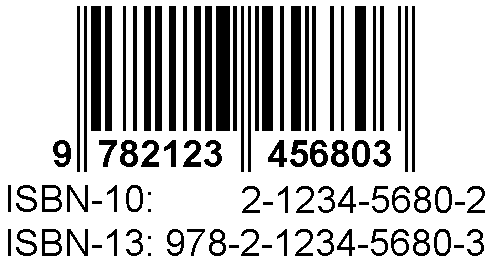
One of the questions I was asked at the Mendocino Coast Writer's Conference was, "What is an ISBN?" There was a great deal of discussion about what that weird bar code on the back of each book means and when a book needs to have one. Not all books do, but if you want to sell a book through a retail outlet, you need one.
Authors don't really need to know what the numbers in the bar code mean (unless their book nerds like me), but every publisher does. The bar code is like the symbol ranchers use to mark their cattle. Every Bar-S ranch cow will have the Bar-S ranch brand. Every Medusa's Muse book will have the numbers 9797152 in their bar code. No other publisher can use those numbers. They are mine, telling stores that the book is a Medusa's Muse book.
Stores use a bar code system to track a books via the book's ISBN. What is a bar code?
From Wikipedia:
A barcode (also bar code) is an optical machine-readable representation of data. Originally, bar codes represented data in the widths (lines) and the spacings of parallel lines, and may be referred to as linear or 1D (1 dimensional) barcodes or symbologies. They also come in patterns of squares, dots, hexagons and other geometric patterns within images termed 2D (2 dimensional) matrix codes or symbologies. Although 2D systems use symbols other than bars, they are generally referred to as barcodes as well.Barcodes can be read by optical scanners called barcode readers, or scanned from an image by special software. In Japan, most mobile phones have built-in scanning software for 2D codes, and similar software is becoming available on smartphone platforms.
If you look at the back of a book you will see a rectangle with two bar codes, usually on the bottom left of the cover. Sometimes there will be a ten digit code, but books published in the last few years will have a 13 digit code. The ISBN standard changed due to the volume of books being published.
The ISBN for What You Need to Know to Be a Pro: The Business Start-Up Guide for Publishers, by Terena Scott, is 978-0-9797152-3-5.
The first three digits identify the type of product it is. 978 means that this is a book.
The next digit identifies the language the book was published in. 0 and 1 are used for English speaking countries.
The center group of numbers is the publisher's ISBN identifier, the brand I wrote of earlier. No other publisher can have the same numbers.
The fourth digit is the number of books published by the publisher. What You Need to Know is the 3rd book published by Medusa's Muse (technically not. This is the second book, but since I set aside two ISBN numbers for Traveling Blind, the next number on the list was the number 3. Nobody cares if the books aren't in order).
The last number is called the check-digit. This is a mathematical variable of the other digits (don't ask me to explain this. Maybe a math person can leave a comment and explain what that means exactly).
You'll see more digits below the code that are the same as the top ISBN digits, but without the dashes. Those numbers show what the bar code means.
Beside the ISBN bar code you'll often see another bar code with numbers on the top. This is the EAN, or European Article Number, which is the world-wide standardization for the sale of books. It tells the price of the book and what system of currency it is sold in. The 5 means that the book is sold in US dollars. What You Need to Know to Be a Pro's EAN looks like this: 5 1 0 0 0, which translates to Ten Dollars US.
And now you know the secret code of an ISBN. Language, currency, price, publisher, and item, all encoded in a bar code for a computer to keep track of books in a store.
Any questions?
Sunday, August 02, 2009
The Mendocino Coast Writer's Conference
On Saturday I was part of a panel called Pathways to Publishing at the Mendocino Coast Writer's Conference. The Mendo Conference is my favorite writer's conference, and not just because it happens at one of the most beautiful places in the world. In only a few days the organizers manage to create a sense of community amongst the attendees based on the love of writing. Everyone is supportive and friendly. There isn't the same competition I've felt at other conferences; participants are genuinely interested in helping each other. Don't think this is a hippi-dippy, kick back kind of conference though. There are agents and editors from New York and the Bay Area offering advice and giving one-on-one consultations as well as award winning writers and poets teaching classes on revision, plot development, character development, writer's block, structure, and pitching. There are lectures about the power of writing to change the world, the needs of a YA reader, and how creative writing and other types of art can stop gangs.
This year I was only able to come for the one day of my talk, but I usually go for the entire three and a half days. In just one day, I met an agent from Manis who was excited about micro-publishinf. I discovered an up and coming author named Benjamin Percy (keep an eye out for him. His short stories are phenomenal. I had lunch with on of my co-panelists,the poet and very funny Robin Ekiss, whose first book debuts this fall. My other co-panelist was Stephanie Freele, whose collection of short stories also debuts this fall.
Our panel went very well and the room was mostly full. We each told how we became published and each of our stories was very different. Stephanie quit her corporate job and got an MFA while Robin went the only route available to poets: contests. I talked about why and how I started my own press and explained all the different paths a writer can take to share their work with the world. The one thing we all focused on was HOPE. Keep trying to get your work out. Keep believing in yourself and your desire to write. Hold fast to your dream. Not all of us will get that contract, but all of us can write and be published. We are not tied to New York City anymore.
Unfortunately I had to leave shortly after the panel. I would have loved to stay and soak up more of that cool, Mendocino Coast air and creative energy, but life is too hectic now days for that. Next year, though. And maybe I'll see you there.
This year I was only able to come for the one day of my talk, but I usually go for the entire three and a half days. In just one day, I met an agent from Manis who was excited about micro-publishinf. I discovered an up and coming author named Benjamin Percy (keep an eye out for him. His short stories are phenomenal. I had lunch with on of my co-panelists,the poet and very funny Robin Ekiss, whose first book debuts this fall. My other co-panelist was Stephanie Freele, whose collection of short stories also debuts this fall.
Our panel went very well and the room was mostly full. We each told how we became published and each of our stories was very different. Stephanie quit her corporate job and got an MFA while Robin went the only route available to poets: contests. I talked about why and how I started my own press and explained all the different paths a writer can take to share their work with the world. The one thing we all focused on was HOPE. Keep trying to get your work out. Keep believing in yourself and your desire to write. Hold fast to your dream. Not all of us will get that contract, but all of us can write and be published. We are not tied to New York City anymore.
Unfortunately I had to leave shortly after the panel. I would have loved to stay and soak up more of that cool, Mendocino Coast air and creative energy, but life is too hectic now days for that. Next year, though. And maybe I'll see you there.
Wednesday, July 29, 2009
Pathways to Publishing.
I'm presenting at the Mendocino Coast Writer's Conference this Saturday on the Pathways to Publishing Panel. It's got me thinking about all the ways there are to get published now days and how lucky we are to not be dependent on publishing companies anymore.
Not that publishing companies are bad! Hell, I am one. But if you don't want to go the route of finding a publisher, you now have many options. In fact, there are FIVE options to get your work out where other people can read it.
Option One - The Traditional Route. This is the one where you find an agent and then the two of you hunt for a publisher, preferably a BIG PUBLISHER, who can give you a BIG ADVANCE and market the book enough that it sells. This is the pot of gold for an author. We all dream of making a deal with Random House or Hatchet and selling thousands of copies of our novel. But competition is fierce and the odds of you actually landing that book deal are slim, especially now days with publishing companies being forced to make budget cuts.
Happily, there are other options.
Option Two- The Micro Publishing Route. This is where you'll find publishing companies like Medusa's Muse. We typically don't work with agents, nor can we afford much of an advance, if at all. But we do offer lots of editorial support and marketing help, as well as making you feel more like you're part of a team than a product. Your book is published by a legitimate publisher, but the odds of selling thousands of copies are slim. No one gets rich in the micro publishing route, and your book may never make the splash you'd like simply because a micro publisher's marketing budget is as micro as the company.
Option Three- The Subsidized Publishing Route. If you'd like to bypass hunting for a publisher but would still like a chance of selling your book, then this is the route for you. This is where you'll find online publishing companies like XLibros and IUniverse. Subsidy publishing has changed for the better over the last decade and a lot of the stigma has disappeared. Working with a subsidy publisher is quick and easy. They'll design and edit your book, for a fee of course. It isn't cheap going this route, and many people have been unhappy with the final result. Plus, you don't own the ISBN, the subsidy publisher does, so that means you don't actually own the book. If that bothers you, then perhaps you should follow option four.
Option Four- The Self Publishing Route. You do it all if you self-publish (so you'll probably want to buy my book, What You Need to Know to Be a Pro). You write it, hire people yourself to edit and design it, send it to a printer, market the book, and sell copies, often from the back of your own car. You will be an author and a business owner, so you also get to do the bookkeeping and track inventory. You'll need a block of ISBN's and a resale license. But all that work allows you to control everything about your book. It's yours, and no one, not an agent or a publishing executive, can tell you what to do. All the profits are yours too. But will it make up for the hours of labor you'll need to put into self-publishing?
Option Five- The Electronic Publishing Route. This is the age of the Internet, so use it. Set up a blog and a website to publish your writing on the net. Post a chapter at a time to serialize your book and start networking with other writers and people who may be interested in your topic to get readers. You won't make any money this way, but you build a following over time which can eventually lead to money in the future, especially if one of those agents we mentioned in Option One likes your work.
I suppose there is an Option Six as well. You can do nothing at all.
Not that publishing companies are bad! Hell, I am one. But if you don't want to go the route of finding a publisher, you now have many options. In fact, there are FIVE options to get your work out where other people can read it.
Option One - The Traditional Route. This is the one where you find an agent and then the two of you hunt for a publisher, preferably a BIG PUBLISHER, who can give you a BIG ADVANCE and market the book enough that it sells. This is the pot of gold for an author. We all dream of making a deal with Random House or Hatchet and selling thousands of copies of our novel. But competition is fierce and the odds of you actually landing that book deal are slim, especially now days with publishing companies being forced to make budget cuts.
Happily, there are other options.
Option Two- The Micro Publishing Route. This is where you'll find publishing companies like Medusa's Muse. We typically don't work with agents, nor can we afford much of an advance, if at all. But we do offer lots of editorial support and marketing help, as well as making you feel more like you're part of a team than a product. Your book is published by a legitimate publisher, but the odds of selling thousands of copies are slim. No one gets rich in the micro publishing route, and your book may never make the splash you'd like simply because a micro publisher's marketing budget is as micro as the company.
Option Three- The Subsidized Publishing Route. If you'd like to bypass hunting for a publisher but would still like a chance of selling your book, then this is the route for you. This is where you'll find online publishing companies like XLibros and IUniverse. Subsidy publishing has changed for the better over the last decade and a lot of the stigma has disappeared. Working with a subsidy publisher is quick and easy. They'll design and edit your book, for a fee of course. It isn't cheap going this route, and many people have been unhappy with the final result. Plus, you don't own the ISBN, the subsidy publisher does, so that means you don't actually own the book. If that bothers you, then perhaps you should follow option four.
Option Four- The Self Publishing Route. You do it all if you self-publish (so you'll probably want to buy my book, What You Need to Know to Be a Pro). You write it, hire people yourself to edit and design it, send it to a printer, market the book, and sell copies, often from the back of your own car. You will be an author and a business owner, so you also get to do the bookkeeping and track inventory. You'll need a block of ISBN's and a resale license. But all that work allows you to control everything about your book. It's yours, and no one, not an agent or a publishing executive, can tell you what to do. All the profits are yours too. But will it make up for the hours of labor you'll need to put into self-publishing?
Option Five- The Electronic Publishing Route. This is the age of the Internet, so use it. Set up a blog and a website to publish your writing on the net. Post a chapter at a time to serialize your book and start networking with other writers and people who may be interested in your topic to get readers. You won't make any money this way, but you build a following over time which can eventually lead to money in the future, especially if one of those agents we mentioned in Option One likes your work.
I suppose there is an Option Six as well. You can do nothing at all.
Monday, July 27, 2009
Goodbye Merce Cunningham

from the BBC:
US choreographer Merce Cunningham, widely recognised for revolutionising modern dance, has died "of natural causes" at the age of 90.
In a statement, the Cunningham Dance Foundation, which he founded in 1953, said that he "revolutionised the visual and performing arts, not for the sake of iconoclasm, but for the beauty and wonder that lay in exploring new possibilities".
Follow the link to see video of some of his work, and hear him speak about courage.
"Courage... when you're doing something that you want to do. You may even not know how to do it, but you still want to do it, so you go ahead and try..." Merce Cunningham.
May we all live such long, vibrant and creative lives.
Saturday, July 25, 2009
Writing the Punk Rock Introduction
At last, the punk book is DONE. Well... mostly.
I know I already said the book was done, but what I meant is that the writers are done. And my editing is done. Now the designer has to lay out everything and add some awesome photos.
But first, I have to write the intro.
Yep, I got everyone's parts completed but neglected to finish (as in start) my own.
And now I'm looking at this lap stop screen with a completely blank brain.
I need to write my own punk rock story and explain how that inspired Punk Rock Saved My Ass.
So let's see...Well... Once upon a time there was a hippi girl who met a punk boy and she fell in love with his music. Even though the relationship didn't last, her love of punk did... and that's why she put this book together... the end.
Yeah. That could work. Too short to suck is always a good thing.
I'm thinking I need to flush it out a bit more, though.
Dang.
If you need me, I'll be trying to explain how this Hippi Chick from Northern California came to love Punk Rock music. Is there such a thing as a Hippi-Punk?
I know I already said the book was done, but what I meant is that the writers are done. And my editing is done. Now the designer has to lay out everything and add some awesome photos.
But first, I have to write the intro.
Yep, I got everyone's parts completed but neglected to finish (as in start) my own.
And now I'm looking at this lap stop screen with a completely blank brain.
I need to write my own punk rock story and explain how that inspired Punk Rock Saved My Ass.
So let's see...Well... Once upon a time there was a hippi girl who met a punk boy and she fell in love with his music. Even though the relationship didn't last, her love of punk did... and that's why she put this book together... the end.
Yeah. That could work. Too short to suck is always a good thing.
I'm thinking I need to flush it out a bit more, though.
Dang.
If you need me, I'll be trying to explain how this Hippi Chick from Northern California came to love Punk Rock music. Is there such a thing as a Hippi-Punk?
Thursday, July 23, 2009
Who is Medusa's Muse?
That question has been haunting me lately. Who is Medusa's Muse? What do the words, Medusa's Muse mean? And what do I want to do with my press, and this blog?
Since I started grad school in September last year, the majority of my energy has gone into intellectual, analytical, systematic thinking. School requires this kind of work. At the same time I was writing a factual, how-to hand-book on starting a publishing company (What You Need to Know to Be a Pro: The Business Start-Up Guide for Publishers, by Terena Scott). Between homework, managing my press, finishing a non-fiction book, and taking care of my daughter's needs, I had almost no time for creative thought. The biggest creative outlet I had in the past 12 months has been The Sims (Yes, it is a creative outlet. Just ask my Sims family). But playing the Sims isn't writing.
My brain is weary from all that linear thinking. I need some creative, imaginative expression.
I'm looking for more balance in my life which has me questioning my choices. School is important so I won't give that up, and Medusa's Muse is my passion. Eventually I'll be finished with school which means I'll be working while also raising my child. How will I have time to keep Medusa's Muse going?
That's why I'm asking: Who is Medusa's Muse? What kind of books do I want to publish? What kind of writers do I want to work with? And is Medusa's Muse only about books and writing? What more can I do to keep my wild, creatively fueled mind thriving?
It also feels like this blog needs to change. But in what way? I'd like to expand the focus on ways to feed all of our muses so that we are creatively alive. Of course I will continue sharing information about running a book press and news on the industry, because it is just as important to know how to manage your inventory and market your books as it is to be artistic. A thriving artist needs to be practical as well as imaginative. You have to work hard so you can pay the electric bill. It's impossible to use your lap top when the battery is dead. But don't work so hard your creative muscles atrophy. Great artists need inspiration and imagination, as well as food and shelter.
My Muse is smiling at me right now because I finally have the answer. Who is Medusa's Muse? She is the Muse of practical imagination.
Since I started grad school in September last year, the majority of my energy has gone into intellectual, analytical, systematic thinking. School requires this kind of work. At the same time I was writing a factual, how-to hand-book on starting a publishing company (What You Need to Know to Be a Pro: The Business Start-Up Guide for Publishers, by Terena Scott). Between homework, managing my press, finishing a non-fiction book, and taking care of my daughter's needs, I had almost no time for creative thought. The biggest creative outlet I had in the past 12 months has been The Sims (Yes, it is a creative outlet. Just ask my Sims family). But playing the Sims isn't writing.
My brain is weary from all that linear thinking. I need some creative, imaginative expression.
I'm looking for more balance in my life which has me questioning my choices. School is important so I won't give that up, and Medusa's Muse is my passion. Eventually I'll be finished with school which means I'll be working while also raising my child. How will I have time to keep Medusa's Muse going?
That's why I'm asking: Who is Medusa's Muse? What kind of books do I want to publish? What kind of writers do I want to work with? And is Medusa's Muse only about books and writing? What more can I do to keep my wild, creatively fueled mind thriving?
It also feels like this blog needs to change. But in what way? I'd like to expand the focus on ways to feed all of our muses so that we are creatively alive. Of course I will continue sharing information about running a book press and news on the industry, because it is just as important to know how to manage your inventory and market your books as it is to be artistic. A thriving artist needs to be practical as well as imaginative. You have to work hard so you can pay the electric bill. It's impossible to use your lap top when the battery is dead. But don't work so hard your creative muscles atrophy. Great artists need inspiration and imagination, as well as food and shelter.
My Muse is smiling at me right now because I finally have the answer. Who is Medusa's Muse? She is the Muse of practical imagination.
Monday, July 20, 2009
Gifts from my Muse
My Muse did a great job encouraging me to focus on my creativity and let go of some of my task oriented, linear way of living. And then as soon as the temperature passed 100, she vanished, complaining that her snake-filled hair was too sweaty. I'm pretty sure she went to Hunter S Thompson's memorial birthday party which Johnny Depp was hosting on his yacht, but she never tells me what her plans are. "A Muse doesn't have to explain," she says, just before vanishing in a puff of snake scented smoke.
That's a muse for you; wonderful when you need a good push, but not there to catch you on the other end.
It's a good thing I'm used to her disappearing acts. She appears in a rush of inspiration and insight, then is gone when the wind changes direction, like a sexy, incandescent Mary Poppins. After one of her trips, she brings back stories wrapped in shiny paper and gives them to me. "This one came from the top of Mt. Denali. Be careful, it's very cold. And this fancy one is from a nightclub in Berlin. I thought you'd like the music." She fills me up with characters and ideas and then commands me to write.
I'm lucky. I've never felt like I had nothing to write about. My problem is I have too many stories in my head. My muse is generous, filling me to the brim until I can't absorb one more image and I beg her to stop because I'm feeling sick. "Nonsense," she says. "No one ever died from too many stories. Writers kill themselves when they run out."
I've begun work on a new novel, and it feels wonderful to write something creative again. This time I have no deadline, no set goal, and no sense of impending failure (at least not yet). The story has been in my head for a couple of years and is finally being transformed into words. Because the characters have lived inside me for so long, they flow out from my imagination fully formed and speaking scenes of dialogue. What a relief to write this story after so many months of textbooks and nonfiction. And the fact the Punk book is finished gives me more time to create my own worlds.
And yes, I do still need to double check the invoices before paying the State of California its Sales Tax. Tomorrow. Right now I'm going to write.
That's a muse for you; wonderful when you need a good push, but not there to catch you on the other end.
It's a good thing I'm used to her disappearing acts. She appears in a rush of inspiration and insight, then is gone when the wind changes direction, like a sexy, incandescent Mary Poppins. After one of her trips, she brings back stories wrapped in shiny paper and gives them to me. "This one came from the top of Mt. Denali. Be careful, it's very cold. And this fancy one is from a nightclub in Berlin. I thought you'd like the music." She fills me up with characters and ideas and then commands me to write.
I'm lucky. I've never felt like I had nothing to write about. My problem is I have too many stories in my head. My muse is generous, filling me to the brim until I can't absorb one more image and I beg her to stop because I'm feeling sick. "Nonsense," she says. "No one ever died from too many stories. Writers kill themselves when they run out."
I've begun work on a new novel, and it feels wonderful to write something creative again. This time I have no deadline, no set goal, and no sense of impending failure (at least not yet). The story has been in my head for a couple of years and is finally being transformed into words. Because the characters have lived inside me for so long, they flow out from my imagination fully formed and speaking scenes of dialogue. What a relief to write this story after so many months of textbooks and nonfiction. And the fact the Punk book is finished gives me more time to create my own worlds.
And yes, I do still need to double check the invoices before paying the State of California its Sales Tax. Tomorrow. Right now I'm going to write.
Saturday, July 18, 2009
Happy Birthday, Dr. Hunter S Thompson

A Muse of my Muse, the good Dr. Thompson. A man who danced on the edge of the cliff singing loud Puerto Rican songs with a glass of scotch in one hand and a pistol in the other. Insane, destructive, beautiful, and extremely talented. Let us all raise a toast to a true original.
There will never be another Dr. Hunter S Thompson.
Monday, July 13, 2009
The Muse is Back!
Greetings to you lovely Medusa fans. This is Muse, taking over for Terena because she seems to be suffering from post-semester brain block. This is a common problem with all people who think too much and have spent a great deal of time focused on one highly complex task for too long. She spent five weeks doing nothing but reading text books and writing opinion papers on subjects such as the Pro and Con of discussing budgetary issues during an IEP and the merits and deficiencies of multi-cultural education. Before summer semester, she wrote a how-to book about starting a small press (What You Need to Know to Be a Pro: The Start-Up Business Guide for Publishers) while at the same time going to Graduate School.I have been mostly silent for 8 months, allowing her time to get through this period of single minded dedication to intellect. But no longer.
Today I found her mumbling over inventory lists in preparation for paying sales tax ("Do I pay 8.75% on sales after April 1, or for all sales of that fiscal year?"). Enough is enough! I grabbed her I POD, set it to play every Pearl Jam song she owns, and pushed her out the front door. "Go for a walk and don't stop until you're worn out!"
"But..." she began.
"No buts. I've had it with all this cerebral, non-creative, linear thinking. Go walk it off."
She lowered her head and pouted but did as she was told.
It's all good and well to focus on work that must be done. Eventually Terena will need to get the sales tax paid, and I'm proud of her for being so dedicated to school. But school is over and she can pay the bills next week. I'm taking control of Medusa's Muse now and steering it back on a more imaginative, creatively passionate, productively wild, course.
After all, a Muse can not live by text books alone.
Today I found her mumbling over inventory lists in preparation for paying sales tax ("Do I pay 8.75% on sales after April 1, or for all sales of that fiscal year?"). Enough is enough! I grabbed her I POD, set it to play every Pearl Jam song she owns, and pushed her out the front door. "Go for a walk and don't stop until you're worn out!"
"But..." she began.
"No buts. I've had it with all this cerebral, non-creative, linear thinking. Go walk it off."
She lowered her head and pouted but did as she was told.
It's all good and well to focus on work that must be done. Eventually Terena will need to get the sales tax paid, and I'm proud of her for being so dedicated to school. But school is over and she can pay the bills next week. I'm taking control of Medusa's Muse now and steering it back on a more imaginative, creatively passionate, productively wild, course.
After all, a Muse can not live by text books alone.
Thursday, July 09, 2009
Editing an Author's Work
From the book, What You Need to Know to Be a Pro: The Start-Up Business Guide for Publishers, by Terena Scott
Editing is my favorite part of publishing, the time when you and the author work together to transform the manuscript into a work of art. This is also when you build your relationship with the author and create trust. Editing an author's work requires compassion, dedication, mediation skills, humor, and vigilance. You must find a way to help an author see what improvements need to be made without destroying their often delicate egos. A weepy author can't get any work done, but while you’re supporting them emotionally and creatively, you also need to be tough about deadlines. And don’t be afraid to use your red pen. You are a professional and you need the author to be professional too. Be honest about what needs to be fixed and clear about your expectations.
When critiquing, I start with what's working, and then point out what needs improvement. Usually there's a lot that needs to be changed, so I continue to point out the positives while finding the negatives. It is important to be as specific as possible when offering suggestions. Try not to say things like, "This isn't working for me." Instead, say, "This section feels preachy. Ground it in sensory details and focus more on the character than the message."
Occasionally, you and the author will disagree, and that's when you need to decide if the edit is important. The publisher has the final say and the author must defer to your opinion. Don't make demands the author can't provide, though. This is still the author's voice, her work, her writing, so she isn't going to write like you. If it's a minor detail, let it go. If it changes the plot profoundly, you may need to insist. When working with Laura, she was very attached to her descriptions of the landscape. I wanted those descriptions cut and the focus put back on the action. Slowly she cut them down from several pages to one page, then to a few paragraphs. After many months, I was satisfied with the amount of description remaining. I wanted even more cuts, but I let it go because the remaining descriptions didn't distract too much from the book's pacing. I decided to let her keep some of her descriptions, remembering it was her writing style, not mine.
In the example contract provided above, there is a clause that allows both of you to pull out during the editing process. If the author can't deliver a manuscript acceptable to the publisher by a certain date, the contract is void. She gets her work back and you are free to find a different project. Every now and then, it happens.
Editing is my favorite part of publishing, the time when you and the author work together to transform the manuscript into a work of art. This is also when you build your relationship with the author and create trust. Editing an author's work requires compassion, dedication, mediation skills, humor, and vigilance. You must find a way to help an author see what improvements need to be made without destroying their often delicate egos. A weepy author can't get any work done, but while you’re supporting them emotionally and creatively, you also need to be tough about deadlines. And don’t be afraid to use your red pen. You are a professional and you need the author to be professional too. Be honest about what needs to be fixed and clear about your expectations.
When critiquing, I start with what's working, and then point out what needs improvement. Usually there's a lot that needs to be changed, so I continue to point out the positives while finding the negatives. It is important to be as specific as possible when offering suggestions. Try not to say things like, "This isn't working for me." Instead, say, "This section feels preachy. Ground it in sensory details and focus more on the character than the message."
Occasionally, you and the author will disagree, and that's when you need to decide if the edit is important. The publisher has the final say and the author must defer to your opinion. Don't make demands the author can't provide, though. This is still the author's voice, her work, her writing, so she isn't going to write like you. If it's a minor detail, let it go. If it changes the plot profoundly, you may need to insist. When working with Laura, she was very attached to her descriptions of the landscape. I wanted those descriptions cut and the focus put back on the action. Slowly she cut them down from several pages to one page, then to a few paragraphs. After many months, I was satisfied with the amount of description remaining. I wanted even more cuts, but I let it go because the remaining descriptions didn't distract too much from the book's pacing. I decided to let her keep some of her descriptions, remembering it was her writing style, not mine.
In the example contract provided above, there is a clause that allows both of you to pull out during the editing process. If the author can't deliver a manuscript acceptable to the publisher by a certain date, the contract is void. She gets her work back and you are free to find a different project. Every now and then, it happens.
Tuesday, July 07, 2009
How to Tell When You've Reached the Limit of What You Can Manag
When you forget which day it is and therefor go the wrong appointment, you've reached the limit.
When you can't answer simple questions like what you ate for breakfast without staring into space trying to understand what the word breakfast means, you've reached the limit.
When your to do list has more than six subheadings, you've reached the limit.
When it's the last month of the last quarter of the Fiscal year and you don't know where the invoice file went, you've reached the limit.
When your book gets a wonderful review and it takes you a week to tell your friends and family, let alone post it on your blog, you've reached the limit.
When your website still doesn't have an image of your book's cover after three months, you've reached the limit
When you groan every time the phone rings, or open your inbox, you've reached the limit.
When all you want to do is play the Sims, you've reached the limit.
When you can't figure out what to do when you've reached the limit, you have definitely reached the limit.
Now what?
When you can't answer simple questions like what you ate for breakfast without staring into space trying to understand what the word breakfast means, you've reached the limit.
When your to do list has more than six subheadings, you've reached the limit.
When it's the last month of the last quarter of the Fiscal year and you don't know where the invoice file went, you've reached the limit.
When your book gets a wonderful review and it takes you a week to tell your friends and family, let alone post it on your blog, you've reached the limit.
When your website still doesn't have an image of your book's cover after three months, you've reached the limit
When you groan every time the phone rings, or open your inbox, you've reached the limit.
When all you want to do is play the Sims, you've reached the limit.
When you can't figure out what to do when you've reached the limit, you have definitely reached the limit.
Now what?
Saturday, July 04, 2009
Have You Ever Read the Declaration of Independence?
Imagine how it must have felt to be a Colonist in 1776 and hear these words spoken. Your country has just declared war against its Government, The British Empire, the biggest super power on the planet. The odds are so stacked against your country it will be a miracle if anyone survives. Despite certain death, you all agree to fight.
Wow...
IN CONGRESS, JULY 4, 1776
The unanimous Declaration of the thirteen united States of America
When in the Course of human events it becomes necessary for one people to dissolve the political bands which have connected them with another and to assume among the powers of the earth, the separate and equal station to which the Laws of Nature and of Nature's God entitle them, a decent respect to the opinions of mankind requires that they should declare the causes which impel them to the separation.
We hold these truths to be self-evident, that all men are created equal, that they are endowed by their Creator with certain unalienable Rights, that among these are Life, Liberty and the pursuit of Happiness. — That to secure these rights, Governments are instituted among Men, deriving their just powers from the consent of the governed, — That whenever any Form of Government becomes destructive of these ends, it is the Right of the People to alter or to abolish it, and to institute new Government, laying its foundation on such principles and organizing its powers in such form, as to them shall seem most likely to effect their Safety and Happiness. Prudence, indeed, will dictate that Governments long established should not be changed for light and transient causes; and accordingly all experience hath shewn that mankind are more disposed to suffer, while evils are sufferable than to right themselves by abolishing the forms to which they are accustomed. But when a long train of abuses and usurpations, pursuing invariably the same Object evinces a design to reduce them under absolute Despotism, it is their right, it is their duty, to throw off such Government, and to provide new Guards for their future security. — Such has been the patient sufferance of these Colonies; and such is now the necessity which constrains them to alter their former Systems of Government.
Wow...
IN CONGRESS, JULY 4, 1776
The unanimous Declaration of the thirteen united States of America
When in the Course of human events it becomes necessary for one people to dissolve the political bands which have connected them with another and to assume among the powers of the earth, the separate and equal station to which the Laws of Nature and of Nature's God entitle them, a decent respect to the opinions of mankind requires that they should declare the causes which impel them to the separation.
We hold these truths to be self-evident, that all men are created equal, that they are endowed by their Creator with certain unalienable Rights, that among these are Life, Liberty and the pursuit of Happiness. — That to secure these rights, Governments are instituted among Men, deriving their just powers from the consent of the governed, — That whenever any Form of Government becomes destructive of these ends, it is the Right of the People to alter or to abolish it, and to institute new Government, laying its foundation on such principles and organizing its powers in such form, as to them shall seem most likely to effect their Safety and Happiness. Prudence, indeed, will dictate that Governments long established should not be changed for light and transient causes; and accordingly all experience hath shewn that mankind are more disposed to suffer, while evils are sufferable than to right themselves by abolishing the forms to which they are accustomed. But when a long train of abuses and usurpations, pursuing invariably the same Object evinces a design to reduce them under absolute Despotism, it is their right, it is their duty, to throw off such Government, and to provide new Guards for their future security. — Such has been the patient sufferance of these Colonies; and such is now the necessity which constrains them to alter their former Systems of Government.
Thursday, July 02, 2009
The Worst Writing in the Whole World
David McKenzie of Federal Way, Washington was declared the winner of the Bulwer Lytton Fiction Contest, "where www means 'wretched writers welcome." You can also read an interview with David McKenzie in the San Jose Mercury News.
Follow this link to see his submission, and then try to out do him. Writing bad isn't as easy as it looks.
Here's my attempt:
The road passed the red break house and just kept going, over the horizon to places unseen, never to be seen, by the little girl in the green dress who lived in the red brick house. She wished she could go there, but she had to stay in the yard and watch the cars go by, far away. It made her sad.
Your turn.
Follow this link to see his submission, and then try to out do him. Writing bad isn't as easy as it looks.
Here's my attempt:
The road passed the red break house and just kept going, over the horizon to places unseen, never to be seen, by the little girl in the green dress who lived in the red brick house. She wished she could go there, but she had to stay in the yard and watch the cars go by, far away. It made her sad.
Your turn.
Wednesday, July 01, 2009
Micheal Jackson

I am not what you'd call a Micheal Jackson fan, although I respected his incredible talent. This is a man who was truly unique in the full definition of the word. There was never anyone like him, and I doubt there will ever be another.
His life was tragic. He was so flawed, so gifted, so shattered. As he aged, he seemed to become more and more unreal, alienated from himself and everyone around him. He never had a chance to live in the real world, so he had no grasp of what real was. His talent helped him survive, but also destroyed him. He may have been the loneliest man in the world, despite the fact he was surrounded by millions who adored him.
When Thriller came out in 1983, I had a paper route. Since I lived in the country, I couldn't ride a bicycle to all the homes (spread out over 30 miles), so my mom and I drove a car and blasted Thriller as loud as we dared at 6:00 am on a Sunday. The album became our paper route anthem. To this day I can't help but sing along to Thriller.
Whether you are a fan or not, you can't deny the incredible impact Micheal Jackson has had on our culture and ourselves.
The world does seem emptier now that Micheal is gone.
Sunday, June 28, 2009
Where can you find a good Copy Editor?
Sorry for the long delay. I've been swamped with school (two more weeks and I'll have time to think again!).
Last time, I wrote about how important it is to work with a copy editor before sending your work out to agents. But where do you find one?
The best resource on line to find professional copy editors is at the site Editorial Freelancers Association. This is a professional organization for editors with a strict code of conduct. You know you'll get what you paid for when hiring an editor through the organization. The site has a comprehensive search engine that allows you to type in the qualifications you need in an editor. I searched for a copy editor who specializes in memoir who lives in California and found five people meeting my specifications.
You can also check your local college for instructors or students with excellent English language skills, but they may not be versed in the Chicago Manual of Style, which is the primary tool editors use for journalism and literature. I know many authors short on funds who have had success hiring a grad student.
Craigslist is another online resource where editors advertise. Whenever you hire anyone off the Internet, be careful of scams. Some people will take your money and never deliver what you paid for.
I found this great blog about copy editing called The Slot, written by copy editor Bill Walsh. Good writing, humorous, and full of information for editors and those in need of an editor. I particularly liked "What's a Copy Editor?"
We'll spend good money on a new outfit for a job interview and probably even get our nails done. So why don't we pay for quality editing before we send our work to an agent or publisher?
Last time, I wrote about how important it is to work with a copy editor before sending your work out to agents. But where do you find one?
The best resource on line to find professional copy editors is at the site Editorial Freelancers Association. This is a professional organization for editors with a strict code of conduct. You know you'll get what you paid for when hiring an editor through the organization. The site has a comprehensive search engine that allows you to type in the qualifications you need in an editor. I searched for a copy editor who specializes in memoir who lives in California and found five people meeting my specifications.
You can also check your local college for instructors or students with excellent English language skills, but they may not be versed in the Chicago Manual of Style, which is the primary tool editors use for journalism and literature. I know many authors short on funds who have had success hiring a grad student.
Craigslist is another online resource where editors advertise. Whenever you hire anyone off the Internet, be careful of scams. Some people will take your money and never deliver what you paid for.
I found this great blog about copy editing called The Slot, written by copy editor Bill Walsh. Good writing, humorous, and full of information for editors and those in need of an editor. I particularly liked "What's a Copy Editor?"
We'll spend good money on a new outfit for a job interview and probably even get our nails done. So why don't we pay for quality editing before we send our work to an agent or publisher?
Sunday, June 21, 2009
You just wrote a fabulous book. Now what?
Congratulations! You've actually written, and finished, a book. Lots of people dream of being a writer, and a few of those will sit down and write something, but only a handful will complete an entire manuscript. Before you do anything else, relish this moment of accomplishment. You've done the equivalent of climbing Kilamanjaro. Good for you!
So what's the very first thing you should do before you start sending that beautiful book of yours to potential agents?
HIRE A COPY EDITOR.
I cannot stress this enough: hire a copy editor. Even if you have a PHD in Literature or an MA in English, hire a copy editor. Even if you are the best speller in your entire State and you've got the spelling bee awards to prove it, hire a copy editor. Do not send your lovely novel to agents full of typos. It's like showing up for a job interview wearing a dirty blouse.
I'm assuming you've been passing chapters of your novel to friends and family for feedback, and I'm also assuming those friends and family have been giving you good writing advice (if not, you need to hire a different editor to work on plot and character development). But it shocks me when I see how many writers do not hire a copy editor for a final check of their manuscript. I get plenty of submissions ruined by spelling and grammar errors. Know what I do? Toss it. I am way too busy to work with an author who can't take the time to fix spelling errors. It shows me that they do not take their writing career seriously.
I hire a copy editor for my own writing, as well as for the books I publish via Medusa's Muse (although I don't hire her to edit my blog, which as you see could use the help).
The problem is that none of us can see our own mistakes; we are blinded by the words on the page (what I call writer's goggles. They work a lot like beer goggles). Everyone has this problem, and anyone who thinks they don't are fools. I'll bet you twenty dollars that even President Obama hires a copy editor for his written work.
Where do you find a good copy editor to polish your masterpiece? I'll explain that next time.
So what's the very first thing you should do before you start sending that beautiful book of yours to potential agents?
HIRE A COPY EDITOR.
I cannot stress this enough: hire a copy editor. Even if you have a PHD in Literature or an MA in English, hire a copy editor. Even if you are the best speller in your entire State and you've got the spelling bee awards to prove it, hire a copy editor. Do not send your lovely novel to agents full of typos. It's like showing up for a job interview wearing a dirty blouse.
I'm assuming you've been passing chapters of your novel to friends and family for feedback, and I'm also assuming those friends and family have been giving you good writing advice (if not, you need to hire a different editor to work on plot and character development). But it shocks me when I see how many writers do not hire a copy editor for a final check of their manuscript. I get plenty of submissions ruined by spelling and grammar errors. Know what I do? Toss it. I am way too busy to work with an author who can't take the time to fix spelling errors. It shows me that they do not take their writing career seriously.
I hire a copy editor for my own writing, as well as for the books I publish via Medusa's Muse (although I don't hire her to edit my blog, which as you see could use the help).
The problem is that none of us can see our own mistakes; we are blinded by the words on the page (what I call writer's goggles. They work a lot like beer goggles). Everyone has this problem, and anyone who thinks they don't are fools. I'll bet you twenty dollars that even President Obama hires a copy editor for his written work.
Where do you find a good copy editor to polish your masterpiece? I'll explain that next time.
Tuesday, June 16, 2009
A Great Review of "What You Need to Know to Be a Pro"
My book just got a great review from the Midwest Book Review. Look for it on their website under the section Library Bookwatch: June 2009: The Writing/Publishing Shelf.
Review by James A. Cox, Editor-in-Chief, Midwest Book Review
When it comes to establishing a publishing enterprise, whether for single title self-published authors, or publishers aspiring to create a stable of authors under one imprint, there is no need to re-invent the wheel. Not when Terena Scott has written "What You Need To Know To Be A Pro: The Business Start-Up Guide For Publishers", a comprehensive but thoroughly accessible instruction manual covering all the elements of launching a publishing enterprise from choosing a name, to structuring the fledgling business enterprise, to creating a business plan, to such issues as licenses, financing, office space, and publishing project evaluation on a case by case basis. "What You Need To Know To Be A Pro" addresses working with authors from contracts to editing; the actual publishing of a book from editing to ISBN, to pricing. "What You Need To Know To Be A Pro" also has invaluable, 'real world' advice on launching a book; keeping track of inventory, royalties and taxes; and establishing how many book titles can be managed by the resources available to the publisher. Of special note are the insertions of practical advice from professional in the publishing industry -- including commentary by James A. Cox, the editor-in-chief of the Midwest Book Review and the author of this review. Enhanced with the inclusion of lists of 'Helpful Resources' including a list of 'how to' books, recommended publisher organizations, publisher oriented websites, "What You Need To Know To Be A Pro: The Business Start-Up Guide For Publishers" is particularly recommended to those new to the publishing field and will prove to be as practical and invaluable, as it is insightful and instructional.
The Midwest Book Review has hundreds of book reviews broken down into topics (cooking, history, fantasy, pets, crafts, etc) to help you find the right book for your interests. Publishers and writers should take a look at The Publisher's Bookshelf for a comprehensive list of books on publishing, book marketing, and writing.
I'm reading the review again and I'm just so happy I need to run around the kitchen and squeal like a five year old! Wheeeeeeeeeeeeeeeeeeeee
Review by James A. Cox, Editor-in-Chief, Midwest Book Review
When it comes to establishing a publishing enterprise, whether for single title self-published authors, or publishers aspiring to create a stable of authors under one imprint, there is no need to re-invent the wheel. Not when Terena Scott has written "What You Need To Know To Be A Pro: The Business Start-Up Guide For Publishers", a comprehensive but thoroughly accessible instruction manual covering all the elements of launching a publishing enterprise from choosing a name, to structuring the fledgling business enterprise, to creating a business plan, to such issues as licenses, financing, office space, and publishing project evaluation on a case by case basis. "What You Need To Know To Be A Pro" addresses working with authors from contracts to editing; the actual publishing of a book from editing to ISBN, to pricing. "What You Need To Know To Be A Pro" also has invaluable, 'real world' advice on launching a book; keeping track of inventory, royalties and taxes; and establishing how many book titles can be managed by the resources available to the publisher. Of special note are the insertions of practical advice from professional in the publishing industry -- including commentary by James A. Cox, the editor-in-chief of the Midwest Book Review and the author of this review. Enhanced with the inclusion of lists of 'Helpful Resources' including a list of 'how to' books, recommended publisher organizations, publisher oriented websites, "What You Need To Know To Be A Pro: The Business Start-Up Guide For Publishers" is particularly recommended to those new to the publishing field and will prove to be as practical and invaluable, as it is insightful and instructional.
The Midwest Book Review has hundreds of book reviews broken down into topics (cooking, history, fantasy, pets, crafts, etc) to help you find the right book for your interests. Publishers and writers should take a look at The Publisher's Bookshelf for a comprehensive list of books on publishing, book marketing, and writing.
I'm reading the review again and I'm just so happy I need to run around the kitchen and squeal like a five year old! Wheeeeeeeeeeeeeeeeeeeee
Sunday, June 14, 2009
Why Don't People Read my Blog?
First, let me say to all my readers, especially those 16 who subscribe and have stayed through all my ramblings, how much I love and appreciate you. This post in no way belittles your support.
But now, I want to know something. Why is it that no matter what I write or do or say, Medusa's Muse is not one of the top blogs on publishing? This blog has been up and running for five years. I've done everything I'm supposed to do: visit other blogs, comment, share info, provide proper credit, write informative posts with the occasional just for fun bit, and give away books. No matter what, I can't get any more readers.
I'm asking because it's not just me who asks these questions. I hear other bloggers complaining of the same thing. They write great content, but no one knows their blog exists. And with the internet so crowded and stuffed with information, I don't know how anyone finds a blog. What's a blogger to do?
I found this article on Copyblogger which addresses those questions. Here is a snippit:
The Oldest Blogging Myth
“Content is king.”
It sounds good in principle. Produce a truly great piece of content, and you’ll get all the links you could ever hope for.
Maybe it worked too, several years ago. The Web used to be a fairly quiet place compared to what it is now, and it was easier for people to notice great blog posts.
But not anymore.
Now great is no longer good enough. The Web is full of so much remarkable content that bloggers don’t have enough time to read it all, much less link to it.
If you want links now, you need to be more than great. You need to be connected.
(Follow the above link for the full story. If you don't know Copyblogger, you need to check them out, and then bookmark them. Great stuff).
It's a great article with good advice, but I realized that I've been doing those things and I still can't get a date to the prom. If it really is about connections and "who you know," then the internet has turned into a giant high school and I'm back to being that Drama nerd everyone made fun of.
Fine! Me and my 16 nerdy subscribers can still have fun. Right guys?
But now, I want to know something. Why is it that no matter what I write or do or say, Medusa's Muse is not one of the top blogs on publishing? This blog has been up and running for five years. I've done everything I'm supposed to do: visit other blogs, comment, share info, provide proper credit, write informative posts with the occasional just for fun bit, and give away books. No matter what, I can't get any more readers.
I'm asking because it's not just me who asks these questions. I hear other bloggers complaining of the same thing. They write great content, but no one knows their blog exists. And with the internet so crowded and stuffed with information, I don't know how anyone finds a blog. What's a blogger to do?
I found this article on Copyblogger which addresses those questions. Here is a snippit:
The Oldest Blogging Myth
“Content is king.”
It sounds good in principle. Produce a truly great piece of content, and you’ll get all the links you could ever hope for.
Maybe it worked too, several years ago. The Web used to be a fairly quiet place compared to what it is now, and it was easier for people to notice great blog posts.
But not anymore.
Now great is no longer good enough. The Web is full of so much remarkable content that bloggers don’t have enough time to read it all, much less link to it.
If you want links now, you need to be more than great. You need to be connected.
(Follow the above link for the full story. If you don't know Copyblogger, you need to check them out, and then bookmark them. Great stuff).
It's a great article with good advice, but I realized that I've been doing those things and I still can't get a date to the prom. If it really is about connections and "who you know," then the internet has turned into a giant high school and I'm back to being that Drama nerd everyone made fun of.
Fine! Me and my 16 nerdy subscribers can still have fun. Right guys?
Thursday, June 11, 2009
Book Written on a Toilet Paper Roll
This is a brilliant idea:
Toilet Paper Horror Novel
It's a perfect example of thinking outside the ordinary. Of course this story should be written on a toilet paper roll because it is based on a Japanese folk tale about a creature who lives in the toilet.
We in the book world tend to hold on too tightly to our ideals of the hallowed halls of traditional publishing. But this is a new century, people. Dust off your creativity and think outside those halls.
Toilet Paper Horror Novel
It's a perfect example of thinking outside the ordinary. Of course this story should be written on a toilet paper roll because it is based on a Japanese folk tale about a creature who lives in the toilet.
We in the book world tend to hold on too tightly to our ideals of the hallowed halls of traditional publishing. But this is a new century, people. Dust off your creativity and think outside those halls.
Monday, June 08, 2009
San Francisco State
My Muse and I strolled the grounds of San Francisco State University today. It was freezing cold with thick, gray fog hanging on the treetops. A perfect, almost summer day in San Fran.
This is where I got my BA in Drama, back in 199... a while ago. I was a wanna be actress turned director, crazy about the theater, especially Commedia and Molier. My plan was to get my degree and run off to New York City where I would dazzle the world with the adventurous, one woman plays I would write, and where I would be discovered by Johnny Depp and then live happily every after.
Funny how life takes drastic detours.
But the theater taught me a lot about writing, and directing taught me even more about publishing. I got an incredible education on how to manage people, transform disparate elements into a cohesive whole, keep all the various pieces organized, and do it all under a deadline. I discovered back then that I am skilled in seeing the "Big Picture," something I continually work with as I create books.
And it is through my publishing that I am back at my alma mater, this time in the Orientation Mobility Master's Program. Laura's book inspired me to go back to school and become a teacher myself.
I am now enrolled in the Summer Semester intensive. I'm taking 6 units (two classes) in 5 weeks. It could be crazy, but right now I'm enjoying this calm before the stress. I'm back in the city I love. I get to spend the entire week doing nothing but schoolwork, without the interruption of being a Mommy. I'll be able to concentrate and might be able to hear myself think for a change. And on the weekends I go home to my daughter and hubby. I know it sounds weird, but this going to school in San Fran is like a vacation for me.
Unfortunatley I will have zero time to write, and my blog posts may get sporadic. Good thing I finished the first draft of the anthology and sent it to Jane and Rick. Jane will do her editing voodoo and Rick will start inserting photos for the stories. When I'm done with school, we should have a book.
This is where I got my BA in Drama, back in 199... a while ago. I was a wanna be actress turned director, crazy about the theater, especially Commedia and Molier. My plan was to get my degree and run off to New York City where I would dazzle the world with the adventurous, one woman plays I would write, and where I would be discovered by Johnny Depp and then live happily every after.
Funny how life takes drastic detours.
But the theater taught me a lot about writing, and directing taught me even more about publishing. I got an incredible education on how to manage people, transform disparate elements into a cohesive whole, keep all the various pieces organized, and do it all under a deadline. I discovered back then that I am skilled in seeing the "Big Picture," something I continually work with as I create books.
And it is through my publishing that I am back at my alma mater, this time in the Orientation Mobility Master's Program. Laura's book inspired me to go back to school and become a teacher myself.
I am now enrolled in the Summer Semester intensive. I'm taking 6 units (two classes) in 5 weeks. It could be crazy, but right now I'm enjoying this calm before the stress. I'm back in the city I love. I get to spend the entire week doing nothing but schoolwork, without the interruption of being a Mommy. I'll be able to concentrate and might be able to hear myself think for a change. And on the weekends I go home to my daughter and hubby. I know it sounds weird, but this going to school in San Fran is like a vacation for me.
Unfortunatley I will have zero time to write, and my blog posts may get sporadic. Good thing I finished the first draft of the anthology and sent it to Jane and Rick. Jane will do her editing voodoo and Rick will start inserting photos for the stories. When I'm done with school, we should have a book.
Friday, June 05, 2009
Judging a Writing Contest
Several months ago I was asked if I'd be willing to judge a writing contest. The organization who asked me is well respected with a good reputation, so I said yes. Then I forgot about it. Three weeks ago I got an email asking if I could still do it, and then last week, I got a packet in the mail stuffed with entries. Luckily, it was a flash fiction contest, so they were all short.
I've never judged a contest before and it felt weird being a judge after many years of being a writer who never won a single contest (or any kind of contest) in her life. What made me think I could judge the worthiness of a story? But I rolled up my editing sleeves and got to work.
This was a blind contest, so I had no idea who the author was or where they came from; the writing had to stand on it's own, as it should. There were two other judges, one of whom I knew, but we didn't talk until we had narrowed the field to our personal top five.
How do you judge a person's writing? What are the elements that make a good story? And how do you set aside your personal likes and dislikes to objectively judge a story on its writing skill rather than just the content?
Start with what's easiest, the mechanics of the story: spelling, punctuation, grammar, tense, and structure. Once I had weeded out the stories with mechanical issues (about half! Come on, people! When you enter a contest have someone edit it for spelling mistakes), I could move on to the next issue: does it meet the criteria for flash fiction?
According to Wikipedia, Flash Fiction "is basically a complete story - having a beginning, middle, and end - which confines itself to a very low word count." This contest required that the story be less than 500 words.
I read each remaining story a second time, looking for structure. Did it have a clear plot, with a protagonist, a challenge or obstacle that the protagonist must cope with, and was the protagonist changed in any way by that obstacle? Did it have a satisfying ending?
This is where the problem of subjectivity comes in because what feels like a satisfying story to me may not satisfy the literary needs of another judge. Which is exactly what happened. Each judge had chosen different stories.
The discussion began. My favorite story was ruled out by the other two judges because they felt it wasn't a complete story, but one of the stories they liked didn't meet my requirements for a complete story. We narrowed our choices down to five finalists and then discussed the merits of each. There was one story neither of the other judges liked, but after I argued in favor of its strengths they agreed it shouldn't be eliminated. I also agreed to keep a story I didn't personally like, but which met the criteria of flash fiction. The back and forth and comparing of notes went on for days.
Finally, we agreed on our winners.
I think about all the various writing contests I've entered over the years and what the discussion might have been amongst the judges. Hopefully I made it to at least the top twenty (I ALWAYS triple check my spelling when submitting work). I have a new respect for judges now that I know how difficult it is to chose a "winning work." And ultimately, it really does come down to what a judge personally thinks should comprise a great story. No matter how many times you check your spelling, you can't get around that.
I've never judged a contest before and it felt weird being a judge after many years of being a writer who never won a single contest (or any kind of contest) in her life. What made me think I could judge the worthiness of a story? But I rolled up my editing sleeves and got to work.
This was a blind contest, so I had no idea who the author was or where they came from; the writing had to stand on it's own, as it should. There were two other judges, one of whom I knew, but we didn't talk until we had narrowed the field to our personal top five.
How do you judge a person's writing? What are the elements that make a good story? And how do you set aside your personal likes and dislikes to objectively judge a story on its writing skill rather than just the content?
Start with what's easiest, the mechanics of the story: spelling, punctuation, grammar, tense, and structure. Once I had weeded out the stories with mechanical issues (about half! Come on, people! When you enter a contest have someone edit it for spelling mistakes), I could move on to the next issue: does it meet the criteria for flash fiction?
According to Wikipedia, Flash Fiction "is basically a complete story - having a beginning, middle, and end - which confines itself to a very low word count." This contest required that the story be less than 500 words.
I read each remaining story a second time, looking for structure. Did it have a clear plot, with a protagonist, a challenge or obstacle that the protagonist must cope with, and was the protagonist changed in any way by that obstacle? Did it have a satisfying ending?
This is where the problem of subjectivity comes in because what feels like a satisfying story to me may not satisfy the literary needs of another judge. Which is exactly what happened. Each judge had chosen different stories.
The discussion began. My favorite story was ruled out by the other two judges because they felt it wasn't a complete story, but one of the stories they liked didn't meet my requirements for a complete story. We narrowed our choices down to five finalists and then discussed the merits of each. There was one story neither of the other judges liked, but after I argued in favor of its strengths they agreed it shouldn't be eliminated. I also agreed to keep a story I didn't personally like, but which met the criteria of flash fiction. The back and forth and comparing of notes went on for days.
Finally, we agreed on our winners.
I think about all the various writing contests I've entered over the years and what the discussion might have been amongst the judges. Hopefully I made it to at least the top twenty (I ALWAYS triple check my spelling when submitting work). I have a new respect for judges now that I know how difficult it is to chose a "winning work." And ultimately, it really does come down to what a judge personally thinks should comprise a great story. No matter how many times you check your spelling, you can't get around that.
Tuesday, June 02, 2009
Draft One of Punk Anthology DONE
Putting a book together is my favorite part of being a publisher. I sit at my desk with a stack of story pages, freshly edited and clean, and I piece the manuscript together into a cohesive book. With a single author, the process begins from the first draft they send me. I make notes and hunt for the thread that ties everything together. Often the author can't see it, but has created the unifying thread intuitively. When I show them what they've created, the author responds as if I've given away the secret of a magic trick. They didn't realize they'd done the magic themselves.
This time, I've been working with multiple authors, helping them craft stories from their experiences as Punks. Many of these authors are not writers, but they all have great stories to tell. They had to be shown the basics of how to write that story down on paper in a way that will be clear and entertaining for the reader. Most of the authors who originally submitted their stories to me two years ago have continued to work on them, taking my feedback and revising over and over and over... until at last their stories are complete. Only a few dropped out.
And now it's my turn to take those stories and create a book.
I had to decide what order to place the stories. Which one will be first? Which on last? How do I intersperse the funny stories with the sad ones? Where do I put the poetry? How many images do we have? Every story has its own pacing and tone, so where I put it will change the overall pacing and tone of the book. How do they all fit together? Or do they? And if some don't fit easily, where do I want to put them to play with that conflict?
I'm sure I'll redo the structure of the anthology numerous times before I get the right pacing for the book. The book needs a beginning, middle and end. It needs conflict and resolution. Each piece provides those elements to the whole of the book. Putting them in the right order is the important part.
This time, I've been working with multiple authors, helping them craft stories from their experiences as Punks. Many of these authors are not writers, but they all have great stories to tell. They had to be shown the basics of how to write that story down on paper in a way that will be clear and entertaining for the reader. Most of the authors who originally submitted their stories to me two years ago have continued to work on them, taking my feedback and revising over and over and over... until at last their stories are complete. Only a few dropped out.
And now it's my turn to take those stories and create a book.
I had to decide what order to place the stories. Which one will be first? Which on last? How do I intersperse the funny stories with the sad ones? Where do I put the poetry? How many images do we have? Every story has its own pacing and tone, so where I put it will change the overall pacing and tone of the book. How do they all fit together? Or do they? And if some don't fit easily, where do I want to put them to play with that conflict?
I'm sure I'll redo the structure of the anthology numerous times before I get the right pacing for the book. The book needs a beginning, middle and end. It needs conflict and resolution. Each piece provides those elements to the whole of the book. Putting them in the right order is the important part.
Saturday, May 30, 2009
Jane is Back!
Jane Mackay is the copy-editor at Medusa's Muse who dedicates HOURS to the Medusa cause. She is also my very dear friend and writing partner. She's been away at college in Boston for the last two years but has graduated and is now back in California. To that, I say...
YIIIIIIIPEEEEEE!
Jane helped me start Medusa's Muse and is one of the people who continues to support my struggles and keep the press alive. Without her incredible grammar talents and creative vision, and the technological know-how of Rick, I couldn't be a publisher. So having her back in the hood is not only wonderful for me personally, it is fantastic for the press. Even though we've stayed in touched and worked together via email while she's been away, having her nearby makes running my press less daunting. It's given me a jolt of energy that I've been missing these last few months while slogging through school. And it's perfect timing, because the Punk Anthology is (believe it or not) ready for the final version and I will definitely need her help to get it ready for the designer.
Trying to do all the work a book publishing company needs all on your own is pretty much impossible. I've heard of a few people who've done it, but I'm not convinced they're sane. It's important to surround yourself with people you can share some of the work with and bounce ideas off. Jane is that person for me, and she usually has chocolate in her purse.
YIIIIIIIPEEEEEE!
Jane helped me start Medusa's Muse and is one of the people who continues to support my struggles and keep the press alive. Without her incredible grammar talents and creative vision, and the technological know-how of Rick, I couldn't be a publisher. So having her back in the hood is not only wonderful for me personally, it is fantastic for the press. Even though we've stayed in touched and worked together via email while she's been away, having her nearby makes running my press less daunting. It's given me a jolt of energy that I've been missing these last few months while slogging through school. And it's perfect timing, because the Punk Anthology is (believe it or not) ready for the final version and I will definitely need her help to get it ready for the designer.
Trying to do all the work a book publishing company needs all on your own is pretty much impossible. I've heard of a few people who've done it, but I'm not convinced they're sane. It's important to surround yourself with people you can share some of the work with and bounce ideas off. Jane is that person for me, and she usually has chocolate in her purse.
Tuesday, May 26, 2009
Now I get why people love Disneyland
I just returned from several days at Disneyland Park in LA with my daughter. It's her birthday, so we went down with Tama and her daughter Boo-Bug for a Princess loving adventure in the "Happiest Place on Earth."
I have never been a Disney person. I could care less about Mickey Mouse and Sleeping Beauty (although I do like Pirates of the Caribbean). But after this trip, I understand why people fall in love with all things Disney.
My daughter has a disability so I was a little concerned about taking her there. Would she be able to cope with the chaos and noise of an amusement park? Disneyland turned out to be the perfect place for her. The staff are well trained and supportive of people with disabilities and the grounds are completely accessible. We had a fantastic time exploring and chatting with Micky Mouse and Tinker Bell. She even went on a couple of rides (although that dang song is still stuck in my head! You know the one, so I'll spare you).
When it was time to leave she asked, still grinning, "Can we come again next year?"
Absolutely!!!!
Of course, the work at Medusa's Muse has piled up while I was away and the Punk Rock anthology deadline is looming. I'll update the blog with publishing news and how-to's soon. But for now, I'm gonna pop in Pirates the Caribbean one more time and enjoy an extra day of lounging.
I have never been a Disney person. I could care less about Mickey Mouse and Sleeping Beauty (although I do like Pirates of the Caribbean). But after this trip, I understand why people fall in love with all things Disney.
My daughter has a disability so I was a little concerned about taking her there. Would she be able to cope with the chaos and noise of an amusement park? Disneyland turned out to be the perfect place for her. The staff are well trained and supportive of people with disabilities and the grounds are completely accessible. We had a fantastic time exploring and chatting with Micky Mouse and Tinker Bell. She even went on a couple of rides (although that dang song is still stuck in my head! You know the one, so I'll spare you).
When it was time to leave she asked, still grinning, "Can we come again next year?"
Absolutely!!!!
Of course, the work at Medusa's Muse has piled up while I was away and the Punk Rock anthology deadline is looming. I'll update the blog with publishing news and how-to's soon. But for now, I'm gonna pop in Pirates the Caribbean one more time and enjoy an extra day of lounging.
Monday, May 18, 2009
On Vacation, See You Next Week
I won't be posting for a while: I'm going to Disneyland! My last class for this semester is tomorrow and after that my daughter and I are going to D-Land to hunt for Cinderella. She's never been, and I haven't been since high school (grad night. mostly I remember looking for good spots to make out with my boyfriend).
Have a great week everyone!
Have a great week everyone!
Sunday, May 17, 2009
Blogging has Hit the Big Time
Remember when a blog was a fun way to keep a journal that you could share with your friends and any random stranger who happened upon it? Then blogging became part of the way we got our news, with bloggers reporting on events that were previously reserved for the New York Times. Sure, some of those bloggers didn't check their facts and a lot of it was well written gossip, but the opinion makers were often bloggers. Now it seems that everyone has a blog, from President Obama and Nike, to your grandma. And it's mandatory for writers to have blogs.
Now, Amazon is allowing any blogger with an RSS feed to add their content to Amazon.com for Kindle users to download and read. The terms of service are here.
And,even more impressive, there is a special "blogger signing schedule" at Book Expo America this year. Fans can meet and chat with their favorite bloggers, including Jason Boog of Galley Cat, and Amy Riley of My Friend Amy. What should the bloggers sign? Laptops?
Yes, the book industry has changed. No longer are bloggers maligned and scorned; now they have author signings at BEA.
Now, Amazon is allowing any blogger with an RSS feed to add their content to Amazon.com for Kindle users to download and read. The terms of service are here.
And,even more impressive, there is a special "blogger signing schedule" at Book Expo America this year. Fans can meet and chat with their favorite bloggers, including Jason Boog of Galley Cat, and Amy Riley of My Friend Amy. What should the bloggers sign? Laptops?
Yes, the book industry has changed. No longer are bloggers maligned and scorned; now they have author signings at BEA.
Subscribe to:
Posts (Atom)