Celebrate Banned Books Week this week by reading a great book like:
The Adventures of Huckleberry Finn, by Mark Twain
Catcher in the Rye, by JD Salinger
His Dark Materials trilogy, by Philip Pullman
The Kite Runner, by Khaled Hosseini
Any of the Harry Potter Books, by JK Rowling
In the Night Kitchen, by Maurice Sendak,
...or any other book on the banned book list.
Every year, during the last week of September, the American Library Association hosts events across the country celebrating free speech. Follow the above link for more information, including a map showing where books have been banned in the US. It's not just happening in the backwoods of some Southern State, people!
Tuesday, September 29, 2009


Sunday, September 27, 2009
More Delays in Google Books Settlement
The latest from the battle over Google Books.
From an article written by Tom Krazit, at CNET news:
When the Department of Justice made it clear last Friday that it could not support the settlement as written--which would give Google unique rights to scan out-of-print books still protected by copyright law--it said the parties were in talks to amend the settlement. In a joint brief (click for PDF), lawyers the Authors Guild, the Association of American Publishers, and others asked Judge Denny Chin to delay a hearing on whether to approve the settlement while the parties work out the new terms of the settlement with the DOJ.
"Because the parties, after consultation with the DOJ, have determined that the Settlement Agreement that was approved preliminarily in November 2008 will be amended, plaintiffs respectfully submit that the Fairness Hearing should not be held, as scheduled, on October 7," the plaintiffs in the case said in a briefing. They said Google had given them permission to indicate that the company was not opposed to the motion.
The Open Book Alliance, a group of companies and organizations opposed to the settlement, declared victory.
Follow the above link for the full article.
For some background info on the Google Books Settlement, see my 11/2008 blog post, Agreement Reached in Google Copyright Infringement Lawsuit.
Friday, September 25, 2009
Equinox turns me on
Summertime is not my creative friend. I feel stifled and listless the longer the sun shines each day and the hotter the temperature gets. By July, when the thermometer hovers at no less than 95 and the sun stays up until 9 pm, my ability to write prose vanishes. Even my dreams are vapid (I actually dreamed about doing dishes two nights in a row last week).
Now that equinox has come, I feel like my muse plugged my mind into a nuclear power plant. Suddenly I am flush with brilliant ideas, vivid dreams, and an eagerness to sit at my computer all day, writing. Plots are revealed in epic detail. Characters who were once wandering along the page aimlessly suddenly know exactly where they should be going. Words rush through my mind faster than I can write them down, and some of them are good. I am eager to create and resent everything that inhibits me from spending hours doing so.
This is purely psychological, because despite it now being Autumn, the temperature is 100. Summer obviously doesn't care what the calendar says because she refuses to go away without a fight. Or maybe I feel this way because there is less daylight. Instead of crawling into bed at 9:00, worn out and discouraged, I write for an hour. The darkness is soothing. It chases the heat away and tells the world to slow down. Be still. It's dreaming time.
Last night I started rewriting a short story I haven't touched in five years. It's a story concept I love which isn't working, but right now I feel like I've found a way to express what the character is trying to say. The story revolves around a wounded woman, Johnny Depp, and a rock garden. This time, she knows what to do.
Tuesday, September 22, 2009
Reacting to Criticism
I read this great post on copyblogger about dealing with criticism, written by Johnny B. Truant. Here's an excerpt:
One of the most interesting lessons I learned about blogging happened in the basement of a Swiss pub on Christmas Eve.
Back in 1999, my brother and I went to visit our sister in Switzerland. Somehow, we all ended up in this basement room at a pub in Interlaken with some locals. For some reason, the lights started going on and off, and I caught this look on my sister’s face. There had been some groping during one of the dark intervals.
I went up to the offender and said, “Hey. You’re going to need to keep your hands to yourself.”
And he, quite drunk, puffed up and stared into my eyes. He said, “What are you going to do about it, friend? You’re a long way from home.”
Find out what he did by following the above link, and see how this incident taught him skills to handle online critics.
Criticism can be hard to deal with, especially when people get personal and attack me, the writer. No longer are we discussing the pros and cons of my writing, suddenly I'm being forced into defending my honor. It makes me furious when people imply that I'm a moron or an airhead, or even worse. Come on people, can't you be a little creative, or intelligent, and criticize my opinions or writing skill, rather than whether I'm "too stupid to know what she's trying to say"?
What can I do? Fight back, or not respond at all? How do I handle rude or outright nasty critics on-line without getting into a tit-for-tat, "no you're the dummy," "no you're the dummy," argument?
Read Johnny B. Truant's post and get some great advice.
Friday, September 18, 2009
Ode to Opium
My muse lounges on my bed, dressed in a tight, black Victorian corset, black silk bloomers, and stiletto heels. Her snake hair is piled high on her head like a Gibson girl, but she looks more like a porn star vampire than an Edwardian icon. "You know," she says, drawing on a cigarette held in a long ivory holder, "Your surgery would have been a lot more fun with Opium."
I shake my head and glare at her. "Sorry. Can't take the stuff."
"Why? What happens?"
"Makes my psychotic. I see things and hear voices."
"What's wrong with that?" She props herself up on her elbow to look at me. "Lewis Carrol heard lots of voices and he wrote a masterpiece."
"I don't write stories for children."
She grins. "Neither did he." Rolling over on her back she stares at the ceiling. After a moment, she recites, "The blissful cloud of summer-indolence benumb'd my eyes; my pulse grew less and less; Pain had no string, and pleasure's wreath no flower:O, why did ye not melt, and leave my sense unhaunted quite of all but-nothingness?"
"Ode on Indolence, by Keats," I say.
"Very good."
"I love the Romantics, but I don't understand their need, or any other artists need, for narcotics. Opium and alcohol, the writer's crutch. It's bullshit. They're too scared to create something on their own, instead relying on drugs to fuel their imaginations."
She laughs. "I'm kidding! I'm not suggesting you become a drug addict. I can't stand drug addicts, especially the artistic kind. Their own muses have abandoned them so they try to fill the artistic loss with hallucinations."
"They don't have muses?"
My muse sits up slowly, takes a long drag on her cigarette, and then looks at me with such sadness in her eyes I am stunned. "They used to have muses, but the drugs drove them away. The drugs become their muse. And perhaps they are able to create beautiful poetry and images, but they lose their soul with every word they write. If they stop taking the drugs, their muse will come back. But if they can't stop, they will never feel the touch of their muse again, and no other will take her place. They are forever alone." Looking at the cigarette in her hand, she shakes her head. "That's something the Romantics didn't learn until it was too late."
She rises and walks across the room to stand in front of me. We look at each other for a quiet moment until she smiles gently, sadness still showing in her green eyes. "Forget I ever mentioned opium. I'm glad you can't take codeine or morphine, and I'm glad you don't drink or fool with drugs. I like that you're so clean cut."
Then she grins and walks out of the room, her hips swinging as she sings "Goody two, goody two, goody, goody two shoes. Goody two, goody two, goody goody two shoes... Don't drink, don't smoke, what do you do...?"
Tuesday, September 15, 2009
Dirty Dancing

I just finished watching Dirty Dancing for the thousandth time and cried through most of it. I can't believe Patrick Swayze is gone. He was only 57. It was too soon for him to go, too soon for him to stop dancing.
Another icon from my childhood has vanished: Micheal Jackson, Farrah Fawcett, John Hughes, and now Patrick Swayze. All of these people had a big influence on my life, but none more than Patrick Swayze. I saw Dirty Dancing five times in a week and a half when it was at the theater, all just to watch him leap off that stage. I wanted to dance, too.
That was the era of the dance movies: Flashdance, Fame, Dirty Dancing, Staying Alive... and I was an aspiring dancer. I once got in a argument with my step-father when I was 17 about what I wanted to be when I grew up.
"I'm going to be a dancer," I said.
"What the hell are you going to do dancing?"
The Solid Gold Dancers were on TV and I pointed at the television and said, "That."
My step-father burst out laughing, which only made me more determined.
"I can dance on TV, and in the movies."
He shook his head and walked away, mumbling about how I was out of my mind.
"You'll see!" I yelled.
I didn't factor in to my future plans that I'd never taken a dance class in my life (there weren't any classes in Kelseyville, where I grew up). But I was determined. Armed with how-to-do-ballet books and a subscription to Dance magazine, I practiced every move I saw, from the ending scene in Flashdance to the merengue in Dirty Dancing. Luckily I was a natural dancer and when I moved away to college my dream came true when I made it into the Humboldt State Dance troupe. I performed in several shows and even choreographed one. But I could never leap high enough or get my untrained legs to turn out enough. I was competing with students who'd been dancing since they were five years old, while I took my first class at age 19. I wasn't stupid. No amount of determination could make up for lack of training.
So I hung up my dancing shoes and focused on acting.
20 years later, I'm a mom and a writer. Funny how life turns out. But the thrill of dancing never went away. I studied belly dancing for a while and fell in love with ballroom dance. When I'm finished with grad school I have plans to take up Flamenco. And every time I hear the theme song from Fame or Flashdance I get a tingly, move my hips feeling. "What a feeling...Take your passion... And make it happen..."
Patrick Swayze did. He wasn't the greatest actor in town, but boy could that man move.
Saturday, September 12, 2009
Surgery
Well, that does it. There's no way we'll make the deadline now. I had surgery this week which put me on the couch for the past four days, unable to do much more than watch old movies and feel sorry for myself. The surgery was minor and is nothing to worry about, but the recovery is taking longer than I anticipated.
Do I hear laughing?
Okay, okay... I know I'm an unrealistic over-achiever. Yes I had surgery on Tuesday. Yes, that was only four days ago. And yes, I suppose it will take more than four days to heal. But lying on the couch wishing I could take stronger pain pills (I'm allergic to opiates so can't have anything good) is putting a dent in my Wonder Woman image.
My muse just laughs harder.
Monday, September 07, 2009
Sometimes DIY is no fun
We are so close to finishing the punk rock anthology. I keep saying that, but it's true. So very, very close. There's just one last minute essay being revised right now and three bios coming until the entire manuscript will be complete. We've been working on cover designs and choosing photographs and debating which font to use for the title. The date of the launch is looming and now I'm starting to worry we won't make it in time. Not from lack of effort, believe me. I've been pushing this book forward with every ounce of will power and fortitude for two years.
Unfortunately, I am powerless against the forces of time and money.
So is my muse.
"You worry too much," she says while cleaning something blue from one of her snake-strand's teeth.
"The scanner won't work so we can't finish the photos. I have no money to print books, and no time to finish this project. Our deadline is Halloween, but with no time or money, there is no way in hell we'll make it."
"So what?"
"What do you mean so what?"
My muse wipes her fingers delicately on a tissue. "So what if you don't make the deadline?"
"Then I let a lot of people down, especially the writers, many of who have been waiting for two years."
She tucks her snakes back into her hair wrap. "So? Do you really think they'll be so crushed they'll never write again?"
"I've been putting off book launch for a year. I'm tired of writing to them with excuses."
"Ah... so it's your pride that is stressing you out."
"Well yeah. A little. I want to be professional and constantly putting off a book's launch is not professional."
She laughs. "Terena, you're not a professional. You publish books out of your living room and will never make a profit. You are a mother and a graduate student, which means you are sleep deprived and broke. Face reality, sister. It's a wonder you get any books published."
I hate it when she's so blunt, especially when she's right.
"This is supposed to be fun, remember?" She smiles and winks.
Right. Fun. Publishing books is supposed to be fun.
This is supposed to be fun, god-damnit!
Monday, August 31, 2009
Another Great Site to Help with Writing Stress
Here's another great site sent to me from Jane Mackay.
Mindfull Time Management: Relief from overwhelm for entrepreneurs and creative professionals. The latest blog post is called Writing Doesn't Have to Hurt, about how writing for shorter amounts of time regularly makes you more productive than binging on writing for long periods of time, less frequently.
I tend to fall into that last category, looking for a block of time to fully immerse myself in the world of my characters. Those free blocks of time are rare, so my writing time is also rare. Do I really need to block out four hours to write, or can I grab an hour, or even thirty minutes, for my novel and still create quality work?
If shorter bouts of time will help me write more, then I'll give it a try.
Friday, August 28, 2009
Three Sites to Keep us Writing.
I am writing this post from the student center at San Francisco State University, eating potato chips while waiting for class to start in an hour. Back to school for me, which means any personal writing time will be hard to come by.
I know I'm not alone. Finding time to be creative is hard for everyone. Between jobs, children, friends, daily life and housework, family obligations and sleep, it can feel impossible to let your muse out to play. Don't forget to spend time with her, though, or she'll be very, very unhappy. In fact, she might forget to show up the next time you beg for her help, deciding instead she needs to spend time with OTHER, more productive, writers.
To help us get motivated and find the time to write, here are a few handy sites.
The Productive Muse is a blog that helps freelancers stay focused and working. She offers tips and ideas for keeping the pen (or keyboard) moving as well as practical suggestions for managing the workload. Perfect for anyone who'd like to forge a freelance, creative career, or just earn a little money with their writing. Who wouldn't?
Sonia Simone is one of my favorite on-line writers and I am proud that she provided advice to new publishers in my book, What You Need to Know to Be a Pro. Her blog is a great place to find inspiration, and I especially love this post: The Complete Flakes Guide to Getting Things Done.
And when you really need help keeping your butt in the chair to write, check out this handy writing tool my friend and editor Jane Mackay showed me. Dr Wicked's Write or Die. Talk about writing prompts! I KNOW my Muse was involved in creating this thing. I dare any of you to try Kamikazi!
Those are just three of the thousands of tools and resources on the web that will keep our creative energy flowing within the limited time limits we cope with. I'm not giving you any more, though, because you should be WRITING, not reading blogs.
Except mine, of course.
Friday, August 21, 2009
The Music of a Book
For three days, my Muse and I have been obsessing on the individual essays and poetry in the Punk Anthology, listening to the quality of the words to find its unique note, its tone, its melody... Every piece is different, but they must all flow together harmoniously within one larger work: the book.
As the publisher and Medusa's Muse "big-picture" editor, this is my job.
"There are too many short pieces clumped together at the end," I said, growling and rubbing my fingers through my hair furiously.
My Muse slapped my hands. "Stop that. You'll go bald."
"They all share a similar tone and flow together well, but it feels boring. We can't have everything clumped together like that."
"So pull them out one at a time and try inserting them in different places." Muse lifted a short, moment-in-time essay from the stack of contributions and studied it. "Like this one. It's lovely. It's a snapshot of a time and place rather than a manifesto. Could we move it up in the order of the book? I think something like this, which is well written and moody, would create a nice break next to a longer piece more focused on the person's history."
I took the story and studied it. "I see what you mean. What if we put it after Chestnut's story. He talks about community and this story shows that community." On my lap top, I find the story, then cut and paste it to its new position. I study how the one story ends and flows into the next. "Yeah. I like it. This could work."
We read and re-read the anthology, moving stories, reading the manuscript again, swapping position of one with another, then changing our minds and putting them back. One day passes, then another. I begin to see the stories clearly when I close my eyes at night and rearrange them in my dreams. I'm not even sure what I'm looking for. I don't know how the book should flow yet. When it happens, I'll feel it.
One day I discover that I'd put all the "jail stories" together. I moved those, then realized the first poem didn't ring true with the first essay. Not that the stories have to agree, but the tone needs to be complimentary. It's like trying to use snippets of Mozart with Motorhead. They may both work together in a piece (just ask a Mashup artist), but probably not directly next to each other. You need to find the common note, the thread of the story, to tie it all together one at a time. The first story may have nothing in common with the fourth story, but they are tied together by what they share with story number two and three. I need to find the threads to tie everything up.
Muse asked, "If this is a punk book, does it have to flow harmoniously? Aren't you working with a music that enjoys jarring people out of any sense of calm?"
"Musically, yes. But this is a book of personal stories and there is a pattern to them. They don't have to tie together as neatly as a different type of book, but they should still work together to tell the larger tale."
Late into the night, while Muse listened to Exene on her Ipod, I switched two storie's positions and suddenly felt it. The threads were tied and the story flowed easily from one piece to the next. It was done.
I leaned back in my chair and motioned for Muse to join me. We read the book again from beginning to end and when we finished we looked at each other and smiled. Even her snakes grinned and I thought I heard one whisper, "Yes!"
Muse stood tall before me and announced, "You are a genius."
"Genius?"
"Yes. You discovered the music of this book. Not everyone can do that."
I shrugged. "I'm the big picture girl. I can't find spelling errors but I can find a plot."
Monday, August 17, 2009
Who Owns an Electronic Book?

Amazon.com electronically deleted copies of Nineteen Eighty Four and Animal Farm from Kindles, even though those copies had been legitimately purchased by readers. There's irony for you: George Orwell's Nineteen Eighty Four was deleted by Amazon without the knowledge or permission of the Kindle owners. Did you know Amazon could sneak onto your Kindle and erase what you have stored there? Me either.
Who owns an electronic book? When we purchase and download an ebook, are we buying the actual file, like we would a paper book, or are we leasing that file? Is it ours, or does it still belong to the publisher? Amazon's actions seem to say that we are merely borrowing the book for an extended amount of time but they can take the book back any time they want. And if we loan that ebook to someone else, or give it to a friend, we're violating our lease agreement.
These are the same questions the music industry has been struggling with for ten years. Music companies have responded by trying to lock down music files so they cannot be shared or passed from one computer to another. But they haven't been able to stop the proliferation of pirated music. Music companies aren't just fighting internet piracy, they are battling ideology. Millennium kids believe that music should be shared, period. They don't believe uploading songs to Pirate Bay is stealing. The harder the music industry tries to crack down on piracy, the more people resent the control placed on how and when their music is played.
The book industry is starting to deal with these same issues. Ebooks are popping up on pirate sites alongside bootlegged songs. As a publisher, I am forced to evaluate my own ideas of fair use and ownership. How much do I want to control the way the books I publish are read? How much am I willing to give away? Can I give away books and stay in business? Is there any way to stop people from uploading copies of my books for thousands of people to download for free? Should I care?
Amazon went too far and is now being sued for deleting those Kindle books. CEO Jeff Bezos apologized for the company's actions, saying "Our "solution" to the problem was stupid, thoughtless, and painfully out of line with our principles."
But the reason Amazon.com decided to erase those files from Kindles in the first place is because those copies of Nineteen Eighty Four and Animal Farm were illegal. The "publisher" uploaded those files via Amazon's third party distribution system and did not have the right to sell them. When Amazon found out, it deleted the files, then took the extra step of deleting them from Kindles.
Which is why I'm asking the question, "Who owns an ebook?" I understand the need for Amazon to shut down the illegal ebooks on their site, but do they also have the right to sneak onto your Kindle and delete what they want, without your knowledge or permission?
Friday, August 14, 2009
Rejection
Rejection. There's nothing that stings so sharply. From the time you were a kid and none of the other kids would play with you, to the Jr Prom when your date ditched you for someone more popular, rejection has been bruising our egos. If you decide to become an artist, you will be dancing with the barbed-wire of rejection on a daily basis.
What do you do when you produce your best work and the only thing you get for your efforts is a big fat NO scrawled on a form letter? What do you do when you keep getting that big fat NO 100 times?
Before you decide you're a terrible artist who should never write again and start drinking Jack Daniels in your underwear at 2 pm, wait. I'm going to tell you a secret about rejection. And then I'm going to give you some steps to help defy those rejections
Those rejections are written by people and because they are people they are only giving you their opinion. A person's opinion is not gospel. It is their gospel, not everyone's. Not only that, a person's opinion can change, sometimes hourly. They may have read your proposal at 9 am after a big fight with their boyfriend, so they hate everything on their desk at that moment. But if they'd read your proposal at noon, after the boyfriend called to apologize, they instantly loved everything on their desk, including your proposal.
It's an unfair, subjective, process combing through query letters, and to make it all worse, you are one of a thousand who have sent in a query that week. There's no way you won't get 100 rejections.
But what about those 100 rejections? Should you just ignore them and declare all editors and agents are morons?
Absolutely not. Those rejection letters are trying to tell you something, so pay attention. Your query letter may be boring, or has a spelling error. Because of the overwhelming mass of writers all vying for an agents time, the agents are looking for any reason to ignore a query letter, so make sure it is 100% perfection.
Or maybe your book isn't as great as you think it is. No, I'm not saying your a bad artist! I am encouraging you to take a step back and evaluate it with the keen eye of a master artist. A work of art can always be made better, just ask Michelangelo as he was finishing the Sistine Chapel. Your writing may be wonderful, but how is the plot? Are there places where the writing is dull or bogged down with too much description, or not enough? Does it start with a strong scene, or lovely prose that doesn't really grab the reader's attention? Use those rejection letters as an opportunity to rethink your project.
I wrote a novel and sent it to an agent I met at a writer's conference. When I pitched the idea and showed her a sample of my writing she loved it. So I was pretty confident that when I sent her the entire book she'd send me a contract. Wrong. She sent me a lovely rejection letter, praising my writing skill, but "I'm not in love with it." I burst into tears and swore I'd never write again. After the despair (and the Jack Daniels) wore off I took another look at my novel and discovered I had written a boring book. Great characters. Compelling idea. Lovely writing. Boring plot.
I set the book aside and after five years I only now feel that I have the skills to fix this book and make it great.
Never give up. Believe in the work, but be honest with yourself. Delusion can be worse than rejection.
And the good news is, you don't have to rely on an agent or a publisher anymore. You can do it yourself, or work with a micro press who may be more willing to work with a new author. Like me.
Wednesday, August 12, 2009
Remembering John Hughes
I am an enormous John Hughes fan, ever since I cried during The Breakfast Club. I saw myself reflected in the dark haired, off-her-rocker, artistic Allison Reynalds, the girl who buried herself in her over sized coat and shook dandruff on her drawing to make it look like it was snowing. I didn't have the dandruff problem (I don't think), but I definitely was that lost, emotionally disturbed girl when I was 13 and 14 years old. After that movie, I was a John Hughes devotee for life.
Several weeks ago, I had the urge to watch John Hughe's movies again, so I rented the Breakfast Club and Sixteen Candles. I felt the same reaction as I did when I was 17 and saw the Breakfast Club for the first time, crying through most of the film and cheering wildly at the end. How had he managed to show so profoundly the inner workings of the teen-aged psyche?
Last Thursday, John Hughes died of a heart attack. He was 59. I felt like a friend I'd lost touch with a long time ago had died. I was stunned and saddened. He was so young.
Today I stumbled across the book, "Don't You Forget About Me: Contemporary Writers On The Films of John Hughes" edited by Jaime Clark. The book has received mixed reviews, but I'm interested to read how other authors were influenced by his story telling. What made John Hughes movies so compelling? How did he manage to connect so strongly with the angst that was 1980's teen age life? They are classic films now and story tellers of all types can learn from them. Pay attention to how he plays with stereotypes and cliches. He bends those assumptions on their heads by using them to illuminate the inner workings of a character. Those characters stay with us because they reveal hidden parts of ourselves, letting us laugh and learn from our own foibles. That is what a good story should do.
Rest well, John Hughes. And thank you for the inspiration.
Sunday, August 09, 2009
The Writing Itch
Shhhh... I have a secret. I'm writing a new novel. I'm not sure why I'm doing this because I can't think of a worse time to start in on another novel, which will probably wind up like my last novel: rejected by an agent and then reduced to hiding in my file cabinet, shamed and bruised. I start the Fall semester of Grad school in three weeks, plus I'm gearing up to launch the newest title from Medusa's Muse (Punk Rock Saved My Ass). I should be preparing myself mentally and organizationally for a hectic Autumn, not plunging into another 300 page writing project. But I've got that itch and when the Muse starts scratching there's nothing you can do.
That's the problem with creativity; it is rarely rational. I think too many people try to force it to be. We get busy with our jobs, our kids, our ideas, and learn to ignore that annoying, persistent itch to create something. And I think our expectations hold us up, too. If what we create isn't GOOD, or WORTHY, or APPROPRIATE FOR PUBLIC VIEWING, we think it's worthless.
I disagree. My new novel may end up in a box like my last novel, but the outcome isn't the fun part for me. Writing is fun. Creating a whole new world one word at a time and peopling it with characters who I am now getting to know, that's the fun part. I have a general idea of what will happen, but my characters often change their mind mid-write, forcing me to chase after them. Writing this book will take a long time, but that's okay. Not only do I have school work on the horizon, but I am also working on a couple of short stories and outlining another play. Nothing may be finished before I graduate, but who cares?
If you see me huddled over my lap top and typing furiously at our local cafe, letting my coffee go cold, ignoring my homework, and generally looking dazed and wild, you'll know my Muse is in control. When she says scratch, I must obey. To hell with reason. Let me create!
Thursday, August 06, 2009
The Secret Code of the ISBN
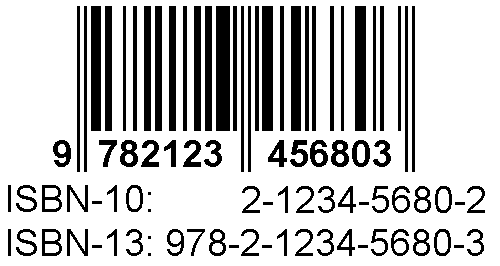
One of the questions I was asked at the Mendocino Coast Writer's Conference was, "What is an ISBN?" There was a great deal of discussion about what that weird bar code on the back of each book means and when a book needs to have one. Not all books do, but if you want to sell a book through a retail outlet, you need one.
Authors don't really need to know what the numbers in the bar code mean (unless their book nerds like me), but every publisher does. The bar code is like the symbol ranchers use to mark their cattle. Every Bar-S ranch cow will have the Bar-S ranch brand. Every Medusa's Muse book will have the numbers 9797152 in their bar code. No other publisher can use those numbers. They are mine, telling stores that the book is a Medusa's Muse book.
Stores use a bar code system to track a books via the book's ISBN. What is a bar code?
From Wikipedia:
A barcode (also bar code) is an optical machine-readable representation of data. Originally, bar codes represented data in the widths (lines) and the spacings of parallel lines, and may be referred to as linear or 1D (1 dimensional) barcodes or symbologies. They also come in patterns of squares, dots, hexagons and other geometric patterns within images termed 2D (2 dimensional) matrix codes or symbologies. Although 2D systems use symbols other than bars, they are generally referred to as barcodes as well.Barcodes can be read by optical scanners called barcode readers, or scanned from an image by special software. In Japan, most mobile phones have built-in scanning software for 2D codes, and similar software is becoming available on smartphone platforms.
If you look at the back of a book you will see a rectangle with two bar codes, usually on the bottom left of the cover. Sometimes there will be a ten digit code, but books published in the last few years will have a 13 digit code. The ISBN standard changed due to the volume of books being published.
The ISBN for What You Need to Know to Be a Pro: The Business Start-Up Guide for Publishers, by Terena Scott, is 978-0-9797152-3-5.
The first three digits identify the type of product it is. 978 means that this is a book.
The next digit identifies the language the book was published in. 0 and 1 are used for English speaking countries.
The center group of numbers is the publisher's ISBN identifier, the brand I wrote of earlier. No other publisher can have the same numbers.
The fourth digit is the number of books published by the publisher. What You Need to Know is the 3rd book published by Medusa's Muse (technically not. This is the second book, but since I set aside two ISBN numbers for Traveling Blind, the next number on the list was the number 3. Nobody cares if the books aren't in order).
The last number is called the check-digit. This is a mathematical variable of the other digits (don't ask me to explain this. Maybe a math person can leave a comment and explain what that means exactly).
You'll see more digits below the code that are the same as the top ISBN digits, but without the dashes. Those numbers show what the bar code means.
Beside the ISBN bar code you'll often see another bar code with numbers on the top. This is the EAN, or European Article Number, which is the world-wide standardization for the sale of books. It tells the price of the book and what system of currency it is sold in. The 5 means that the book is sold in US dollars. What You Need to Know to Be a Pro's EAN looks like this: 5 1 0 0 0, which translates to Ten Dollars US.
And now you know the secret code of an ISBN. Language, currency, price, publisher, and item, all encoded in a bar code for a computer to keep track of books in a store.
Any questions?
Sunday, August 02, 2009
The Mendocino Coast Writer's Conference
On Saturday I was part of a panel called Pathways to Publishing at the Mendocino Coast Writer's Conference. The Mendo Conference is my favorite writer's conference, and not just because it happens at one of the most beautiful places in the world. In only a few days the organizers manage to create a sense of community amongst the attendees based on the love of writing. Everyone is supportive and friendly. There isn't the same competition I've felt at other conferences; participants are genuinely interested in helping each other. Don't think this is a hippi-dippy, kick back kind of conference though. There are agents and editors from New York and the Bay Area offering advice and giving one-on-one consultations as well as award winning writers and poets teaching classes on revision, plot development, character development, writer's block, structure, and pitching. There are lectures about the power of writing to change the world, the needs of a YA reader, and how creative writing and other types of art can stop gangs.
This year I was only able to come for the one day of my talk, but I usually go for the entire three and a half days. In just one day, I met an agent from Manis who was excited about micro-publishinf. I discovered an up and coming author named Benjamin Percy (keep an eye out for him. His short stories are phenomenal. I had lunch with on of my co-panelists,the poet and very funny Robin Ekiss, whose first book debuts this fall. My other co-panelist was Stephanie Freele, whose collection of short stories also debuts this fall.
Our panel went very well and the room was mostly full. We each told how we became published and each of our stories was very different. Stephanie quit her corporate job and got an MFA while Robin went the only route available to poets: contests. I talked about why and how I started my own press and explained all the different paths a writer can take to share their work with the world. The one thing we all focused on was HOPE. Keep trying to get your work out. Keep believing in yourself and your desire to write. Hold fast to your dream. Not all of us will get that contract, but all of us can write and be published. We are not tied to New York City anymore.
Unfortunately I had to leave shortly after the panel. I would have loved to stay and soak up more of that cool, Mendocino Coast air and creative energy, but life is too hectic now days for that. Next year, though. And maybe I'll see you there.
Wednesday, July 29, 2009
Pathways to Publishing.
I'm presenting at the Mendocino Coast Writer's Conference this Saturday on the Pathways to Publishing Panel. It's got me thinking about all the ways there are to get published now days and how lucky we are to not be dependent on publishing companies anymore.
Not that publishing companies are bad! Hell, I am one. But if you don't want to go the route of finding a publisher, you now have many options. In fact, there are FIVE options to get your work out where other people can read it.
Option One - The Traditional Route. This is the one where you find an agent and then the two of you hunt for a publisher, preferably a BIG PUBLISHER, who can give you a BIG ADVANCE and market the book enough that it sells. This is the pot of gold for an author. We all dream of making a deal with Random House or Hatchet and selling thousands of copies of our novel. But competition is fierce and the odds of you actually landing that book deal are slim, especially now days with publishing companies being forced to make budget cuts.
Happily, there are other options.
Option Two- The Micro Publishing Route. This is where you'll find publishing companies like Medusa's Muse. We typically don't work with agents, nor can we afford much of an advance, if at all. But we do offer lots of editorial support and marketing help, as well as making you feel more like you're part of a team than a product. Your book is published by a legitimate publisher, but the odds of selling thousands of copies are slim. No one gets rich in the micro publishing route, and your book may never make the splash you'd like simply because a micro publisher's marketing budget is as micro as the company.
Option Three- The Subsidized Publishing Route. If you'd like to bypass hunting for a publisher but would still like a chance of selling your book, then this is the route for you. This is where you'll find online publishing companies like XLibros and IUniverse. Subsidy publishing has changed for the better over the last decade and a lot of the stigma has disappeared. Working with a subsidy publisher is quick and easy. They'll design and edit your book, for a fee of course. It isn't cheap going this route, and many people have been unhappy with the final result. Plus, you don't own the ISBN, the subsidy publisher does, so that means you don't actually own the book. If that bothers you, then perhaps you should follow option four.
Option Four- The Self Publishing Route. You do it all if you self-publish (so you'll probably want to buy my book, What You Need to Know to Be a Pro). You write it, hire people yourself to edit and design it, send it to a printer, market the book, and sell copies, often from the back of your own car. You will be an author and a business owner, so you also get to do the bookkeeping and track inventory. You'll need a block of ISBN's and a resale license. But all that work allows you to control everything about your book. It's yours, and no one, not an agent or a publishing executive, can tell you what to do. All the profits are yours too. But will it make up for the hours of labor you'll need to put into self-publishing?
Option Five- The Electronic Publishing Route. This is the age of the Internet, so use it. Set up a blog and a website to publish your writing on the net. Post a chapter at a time to serialize your book and start networking with other writers and people who may be interested in your topic to get readers. You won't make any money this way, but you build a following over time which can eventually lead to money in the future, especially if one of those agents we mentioned in Option One likes your work.
I suppose there is an Option Six as well. You can do nothing at all.
Monday, July 27, 2009
Goodbye Merce Cunningham

from the BBC:
US choreographer Merce Cunningham, widely recognised for revolutionising modern dance, has died "of natural causes" at the age of 90.
In a statement, the Cunningham Dance Foundation, which he founded in 1953, said that he "revolutionised the visual and performing arts, not for the sake of iconoclasm, but for the beauty and wonder that lay in exploring new possibilities".
Follow the link to see video of some of his work, and hear him speak about courage.
"Courage... when you're doing something that you want to do. You may even not know how to do it, but you still want to do it, so you go ahead and try..." Merce Cunningham.
May we all live such long, vibrant and creative lives.
Saturday, July 25, 2009
Writing the Punk Rock Introduction
At last, the punk book is DONE. Well... mostly.
I know I already said the book was done, but what I meant is that the writers are done. And my editing is done. Now the designer has to lay out everything and add some awesome photos.
But first, I have to write the intro.
Yep, I got everyone's parts completed but neglected to finish (as in start) my own.
And now I'm looking at this lap stop screen with a completely blank brain.
I need to write my own punk rock story and explain how that inspired Punk Rock Saved My Ass.
So let's see...Well... Once upon a time there was a hippi girl who met a punk boy and she fell in love with his music. Even though the relationship didn't last, her love of punk did... and that's why she put this book together... the end.
Yeah. That could work. Too short to suck is always a good thing.
I'm thinking I need to flush it out a bit more, though.
Dang.
If you need me, I'll be trying to explain how this Hippi Chick from Northern California came to love Punk Rock music. Is there such a thing as a Hippi-Punk?
Subscribe to:
Posts (Atom)