I am writing this post from the student center at San Francisco State University, eating potato chips while waiting for class to start in an hour. Back to school for me, which means any personal writing time will be hard to come by.
I know I'm not alone. Finding time to be creative is hard for everyone. Between jobs, children, friends, daily life and housework, family obligations and sleep, it can feel impossible to let your muse out to play. Don't forget to spend time with her, though, or she'll be very, very unhappy. In fact, she might forget to show up the next time you beg for her help, deciding instead she needs to spend time with OTHER, more productive, writers.
To help us get motivated and find the time to write, here are a few handy sites.
The Productive Muse is a blog that helps freelancers stay focused and working. She offers tips and ideas for keeping the pen (or keyboard) moving as well as practical suggestions for managing the workload. Perfect for anyone who'd like to forge a freelance, creative career, or just earn a little money with their writing. Who wouldn't?
Sonia Simone is one of my favorite on-line writers and I am proud that she provided advice to new publishers in my book, What You Need to Know to Be a Pro. Her blog is a great place to find inspiration, and I especially love this post: The Complete Flakes Guide to Getting Things Done.
And when you really need help keeping your butt in the chair to write, check out this handy writing tool my friend and editor Jane Mackay showed me. Dr Wicked's Write or Die. Talk about writing prompts! I KNOW my Muse was involved in creating this thing. I dare any of you to try Kamikazi!
Those are just three of the thousands of tools and resources on the web that will keep our creative energy flowing within the limited time limits we cope with. I'm not giving you any more, though, because you should be WRITING, not reading blogs.
Except mine, of course.
Friday, August 28, 2009


Friday, August 21, 2009
The Music of a Book
For three days, my Muse and I have been obsessing on the individual essays and poetry in the Punk Anthology, listening to the quality of the words to find its unique note, its tone, its melody... Every piece is different, but they must all flow together harmoniously within one larger work: the book.
As the publisher and Medusa's Muse "big-picture" editor, this is my job.
"There are too many short pieces clumped together at the end," I said, growling and rubbing my fingers through my hair furiously.
My Muse slapped my hands. "Stop that. You'll go bald."
"They all share a similar tone and flow together well, but it feels boring. We can't have everything clumped together like that."
"So pull them out one at a time and try inserting them in different places." Muse lifted a short, moment-in-time essay from the stack of contributions and studied it. "Like this one. It's lovely. It's a snapshot of a time and place rather than a manifesto. Could we move it up in the order of the book? I think something like this, which is well written and moody, would create a nice break next to a longer piece more focused on the person's history."
I took the story and studied it. "I see what you mean. What if we put it after Chestnut's story. He talks about community and this story shows that community." On my lap top, I find the story, then cut and paste it to its new position. I study how the one story ends and flows into the next. "Yeah. I like it. This could work."
We read and re-read the anthology, moving stories, reading the manuscript again, swapping position of one with another, then changing our minds and putting them back. One day passes, then another. I begin to see the stories clearly when I close my eyes at night and rearrange them in my dreams. I'm not even sure what I'm looking for. I don't know how the book should flow yet. When it happens, I'll feel it.
One day I discover that I'd put all the "jail stories" together. I moved those, then realized the first poem didn't ring true with the first essay. Not that the stories have to agree, but the tone needs to be complimentary. It's like trying to use snippets of Mozart with Motorhead. They may both work together in a piece (just ask a Mashup artist), but probably not directly next to each other. You need to find the common note, the thread of the story, to tie it all together one at a time. The first story may have nothing in common with the fourth story, but they are tied together by what they share with story number two and three. I need to find the threads to tie everything up.
Muse asked, "If this is a punk book, does it have to flow harmoniously? Aren't you working with a music that enjoys jarring people out of any sense of calm?"
"Musically, yes. But this is a book of personal stories and there is a pattern to them. They don't have to tie together as neatly as a different type of book, but they should still work together to tell the larger tale."
Late into the night, while Muse listened to Exene on her Ipod, I switched two storie's positions and suddenly felt it. The threads were tied and the story flowed easily from one piece to the next. It was done.
I leaned back in my chair and motioned for Muse to join me. We read the book again from beginning to end and when we finished we looked at each other and smiled. Even her snakes grinned and I thought I heard one whisper, "Yes!"
Muse stood tall before me and announced, "You are a genius."
"Genius?"
"Yes. You discovered the music of this book. Not everyone can do that."
I shrugged. "I'm the big picture girl. I can't find spelling errors but I can find a plot."
As the publisher and Medusa's Muse "big-picture" editor, this is my job.
"There are too many short pieces clumped together at the end," I said, growling and rubbing my fingers through my hair furiously.
My Muse slapped my hands. "Stop that. You'll go bald."
"They all share a similar tone and flow together well, but it feels boring. We can't have everything clumped together like that."
"So pull them out one at a time and try inserting them in different places." Muse lifted a short, moment-in-time essay from the stack of contributions and studied it. "Like this one. It's lovely. It's a snapshot of a time and place rather than a manifesto. Could we move it up in the order of the book? I think something like this, which is well written and moody, would create a nice break next to a longer piece more focused on the person's history."
I took the story and studied it. "I see what you mean. What if we put it after Chestnut's story. He talks about community and this story shows that community." On my lap top, I find the story, then cut and paste it to its new position. I study how the one story ends and flows into the next. "Yeah. I like it. This could work."
We read and re-read the anthology, moving stories, reading the manuscript again, swapping position of one with another, then changing our minds and putting them back. One day passes, then another. I begin to see the stories clearly when I close my eyes at night and rearrange them in my dreams. I'm not even sure what I'm looking for. I don't know how the book should flow yet. When it happens, I'll feel it.
One day I discover that I'd put all the "jail stories" together. I moved those, then realized the first poem didn't ring true with the first essay. Not that the stories have to agree, but the tone needs to be complimentary. It's like trying to use snippets of Mozart with Motorhead. They may both work together in a piece (just ask a Mashup artist), but probably not directly next to each other. You need to find the common note, the thread of the story, to tie it all together one at a time. The first story may have nothing in common with the fourth story, but they are tied together by what they share with story number two and three. I need to find the threads to tie everything up.
Muse asked, "If this is a punk book, does it have to flow harmoniously? Aren't you working with a music that enjoys jarring people out of any sense of calm?"
"Musically, yes. But this is a book of personal stories and there is a pattern to them. They don't have to tie together as neatly as a different type of book, but they should still work together to tell the larger tale."
Late into the night, while Muse listened to Exene on her Ipod, I switched two storie's positions and suddenly felt it. The threads were tied and the story flowed easily from one piece to the next. It was done.
I leaned back in my chair and motioned for Muse to join me. We read the book again from beginning to end and when we finished we looked at each other and smiled. Even her snakes grinned and I thought I heard one whisper, "Yes!"
Muse stood tall before me and announced, "You are a genius."
"Genius?"
"Yes. You discovered the music of this book. Not everyone can do that."
I shrugged. "I'm the big picture girl. I can't find spelling errors but I can find a plot."
Monday, August 17, 2009
Who Owns an Electronic Book?

Amazon.com electronically deleted copies of Nineteen Eighty Four and Animal Farm from Kindles, even though those copies had been legitimately purchased by readers. There's irony for you: George Orwell's Nineteen Eighty Four was deleted by Amazon without the knowledge or permission of the Kindle owners. Did you know Amazon could sneak onto your Kindle and erase what you have stored there? Me either.
Who owns an electronic book? When we purchase and download an ebook, are we buying the actual file, like we would a paper book, or are we leasing that file? Is it ours, or does it still belong to the publisher? Amazon's actions seem to say that we are merely borrowing the book for an extended amount of time but they can take the book back any time they want. And if we loan that ebook to someone else, or give it to a friend, we're violating our lease agreement.
These are the same questions the music industry has been struggling with for ten years. Music companies have responded by trying to lock down music files so they cannot be shared or passed from one computer to another. But they haven't been able to stop the proliferation of pirated music. Music companies aren't just fighting internet piracy, they are battling ideology. Millennium kids believe that music should be shared, period. They don't believe uploading songs to Pirate Bay is stealing. The harder the music industry tries to crack down on piracy, the more people resent the control placed on how and when their music is played.
The book industry is starting to deal with these same issues. Ebooks are popping up on pirate sites alongside bootlegged songs. As a publisher, I am forced to evaluate my own ideas of fair use and ownership. How much do I want to control the way the books I publish are read? How much am I willing to give away? Can I give away books and stay in business? Is there any way to stop people from uploading copies of my books for thousands of people to download for free? Should I care?
Amazon went too far and is now being sued for deleting those Kindle books. CEO Jeff Bezos apologized for the company's actions, saying "Our "solution" to the problem was stupid, thoughtless, and painfully out of line with our principles."
But the reason Amazon.com decided to erase those files from Kindles in the first place is because those copies of Nineteen Eighty Four and Animal Farm were illegal. The "publisher" uploaded those files via Amazon's third party distribution system and did not have the right to sell them. When Amazon found out, it deleted the files, then took the extra step of deleting them from Kindles.
Which is why I'm asking the question, "Who owns an ebook?" I understand the need for Amazon to shut down the illegal ebooks on their site, but do they also have the right to sneak onto your Kindle and delete what they want, without your knowledge or permission?
Friday, August 14, 2009
Rejection
Rejection. There's nothing that stings so sharply. From the time you were a kid and none of the other kids would play with you, to the Jr Prom when your date ditched you for someone more popular, rejection has been bruising our egos. If you decide to become an artist, you will be dancing with the barbed-wire of rejection on a daily basis.
What do you do when you produce your best work and the only thing you get for your efforts is a big fat NO scrawled on a form letter? What do you do when you keep getting that big fat NO 100 times?
Before you decide you're a terrible artist who should never write again and start drinking Jack Daniels in your underwear at 2 pm, wait. I'm going to tell you a secret about rejection. And then I'm going to give you some steps to help defy those rejections
Those rejections are written by people and because they are people they are only giving you their opinion. A person's opinion is not gospel. It is their gospel, not everyone's. Not only that, a person's opinion can change, sometimes hourly. They may have read your proposal at 9 am after a big fight with their boyfriend, so they hate everything on their desk at that moment. But if they'd read your proposal at noon, after the boyfriend called to apologize, they instantly loved everything on their desk, including your proposal.
It's an unfair, subjective, process combing through query letters, and to make it all worse, you are one of a thousand who have sent in a query that week. There's no way you won't get 100 rejections.
But what about those 100 rejections? Should you just ignore them and declare all editors and agents are morons?
Absolutely not. Those rejection letters are trying to tell you something, so pay attention. Your query letter may be boring, or has a spelling error. Because of the overwhelming mass of writers all vying for an agents time, the agents are looking for any reason to ignore a query letter, so make sure it is 100% perfection.
Or maybe your book isn't as great as you think it is. No, I'm not saying your a bad artist! I am encouraging you to take a step back and evaluate it with the keen eye of a master artist. A work of art can always be made better, just ask Michelangelo as he was finishing the Sistine Chapel. Your writing may be wonderful, but how is the plot? Are there places where the writing is dull or bogged down with too much description, or not enough? Does it start with a strong scene, or lovely prose that doesn't really grab the reader's attention? Use those rejection letters as an opportunity to rethink your project.
I wrote a novel and sent it to an agent I met at a writer's conference. When I pitched the idea and showed her a sample of my writing she loved it. So I was pretty confident that when I sent her the entire book she'd send me a contract. Wrong. She sent me a lovely rejection letter, praising my writing skill, but "I'm not in love with it." I burst into tears and swore I'd never write again. After the despair (and the Jack Daniels) wore off I took another look at my novel and discovered I had written a boring book. Great characters. Compelling idea. Lovely writing. Boring plot.
I set the book aside and after five years I only now feel that I have the skills to fix this book and make it great.
Never give up. Believe in the work, but be honest with yourself. Delusion can be worse than rejection.
And the good news is, you don't have to rely on an agent or a publisher anymore. You can do it yourself, or work with a micro press who may be more willing to work with a new author. Like me.
What do you do when you produce your best work and the only thing you get for your efforts is a big fat NO scrawled on a form letter? What do you do when you keep getting that big fat NO 100 times?
Before you decide you're a terrible artist who should never write again and start drinking Jack Daniels in your underwear at 2 pm, wait. I'm going to tell you a secret about rejection. And then I'm going to give you some steps to help defy those rejections
Those rejections are written by people and because they are people they are only giving you their opinion. A person's opinion is not gospel. It is their gospel, not everyone's. Not only that, a person's opinion can change, sometimes hourly. They may have read your proposal at 9 am after a big fight with their boyfriend, so they hate everything on their desk at that moment. But if they'd read your proposal at noon, after the boyfriend called to apologize, they instantly loved everything on their desk, including your proposal.
It's an unfair, subjective, process combing through query letters, and to make it all worse, you are one of a thousand who have sent in a query that week. There's no way you won't get 100 rejections.
But what about those 100 rejections? Should you just ignore them and declare all editors and agents are morons?
Absolutely not. Those rejection letters are trying to tell you something, so pay attention. Your query letter may be boring, or has a spelling error. Because of the overwhelming mass of writers all vying for an agents time, the agents are looking for any reason to ignore a query letter, so make sure it is 100% perfection.
Or maybe your book isn't as great as you think it is. No, I'm not saying your a bad artist! I am encouraging you to take a step back and evaluate it with the keen eye of a master artist. A work of art can always be made better, just ask Michelangelo as he was finishing the Sistine Chapel. Your writing may be wonderful, but how is the plot? Are there places where the writing is dull or bogged down with too much description, or not enough? Does it start with a strong scene, or lovely prose that doesn't really grab the reader's attention? Use those rejection letters as an opportunity to rethink your project.
I wrote a novel and sent it to an agent I met at a writer's conference. When I pitched the idea and showed her a sample of my writing she loved it. So I was pretty confident that when I sent her the entire book she'd send me a contract. Wrong. She sent me a lovely rejection letter, praising my writing skill, but "I'm not in love with it." I burst into tears and swore I'd never write again. After the despair (and the Jack Daniels) wore off I took another look at my novel and discovered I had written a boring book. Great characters. Compelling idea. Lovely writing. Boring plot.
I set the book aside and after five years I only now feel that I have the skills to fix this book and make it great.
Never give up. Believe in the work, but be honest with yourself. Delusion can be worse than rejection.
And the good news is, you don't have to rely on an agent or a publisher anymore. You can do it yourself, or work with a micro press who may be more willing to work with a new author. Like me.
Wednesday, August 12, 2009
Remembering John Hughes
I am an enormous John Hughes fan, ever since I cried during The Breakfast Club. I saw myself reflected in the dark haired, off-her-rocker, artistic Allison Reynalds, the girl who buried herself in her over sized coat and shook dandruff on her drawing to make it look like it was snowing. I didn't have the dandruff problem (I don't think), but I definitely was that lost, emotionally disturbed girl when I was 13 and 14 years old. After that movie, I was a John Hughes devotee for life.
Several weeks ago, I had the urge to watch John Hughe's movies again, so I rented the Breakfast Club and Sixteen Candles. I felt the same reaction as I did when I was 17 and saw the Breakfast Club for the first time, crying through most of the film and cheering wildly at the end. How had he managed to show so profoundly the inner workings of the teen-aged psyche?
Last Thursday, John Hughes died of a heart attack. He was 59. I felt like a friend I'd lost touch with a long time ago had died. I was stunned and saddened. He was so young.
Today I stumbled across the book, "Don't You Forget About Me: Contemporary Writers On The Films of John Hughes" edited by Jaime Clark. The book has received mixed reviews, but I'm interested to read how other authors were influenced by his story telling. What made John Hughes movies so compelling? How did he manage to connect so strongly with the angst that was 1980's teen age life? They are classic films now and story tellers of all types can learn from them. Pay attention to how he plays with stereotypes and cliches. He bends those assumptions on their heads by using them to illuminate the inner workings of a character. Those characters stay with us because they reveal hidden parts of ourselves, letting us laugh and learn from our own foibles. That is what a good story should do.
Rest well, John Hughes. And thank you for the inspiration.
Several weeks ago, I had the urge to watch John Hughe's movies again, so I rented the Breakfast Club and Sixteen Candles. I felt the same reaction as I did when I was 17 and saw the Breakfast Club for the first time, crying through most of the film and cheering wildly at the end. How had he managed to show so profoundly the inner workings of the teen-aged psyche?
Last Thursday, John Hughes died of a heart attack. He was 59. I felt like a friend I'd lost touch with a long time ago had died. I was stunned and saddened. He was so young.
Today I stumbled across the book, "Don't You Forget About Me: Contemporary Writers On The Films of John Hughes" edited by Jaime Clark. The book has received mixed reviews, but I'm interested to read how other authors were influenced by his story telling. What made John Hughes movies so compelling? How did he manage to connect so strongly with the angst that was 1980's teen age life? They are classic films now and story tellers of all types can learn from them. Pay attention to how he plays with stereotypes and cliches. He bends those assumptions on their heads by using them to illuminate the inner workings of a character. Those characters stay with us because they reveal hidden parts of ourselves, letting us laugh and learn from our own foibles. That is what a good story should do.
Rest well, John Hughes. And thank you for the inspiration.
Sunday, August 09, 2009
The Writing Itch
Shhhh... I have a secret. I'm writing a new novel. I'm not sure why I'm doing this because I can't think of a worse time to start in on another novel, which will probably wind up like my last novel: rejected by an agent and then reduced to hiding in my file cabinet, shamed and bruised. I start the Fall semester of Grad school in three weeks, plus I'm gearing up to launch the newest title from Medusa's Muse (Punk Rock Saved My Ass). I should be preparing myself mentally and organizationally for a hectic Autumn, not plunging into another 300 page writing project. But I've got that itch and when the Muse starts scratching there's nothing you can do.
That's the problem with creativity; it is rarely rational. I think too many people try to force it to be. We get busy with our jobs, our kids, our ideas, and learn to ignore that annoying, persistent itch to create something. And I think our expectations hold us up, too. If what we create isn't GOOD, or WORTHY, or APPROPRIATE FOR PUBLIC VIEWING, we think it's worthless.
I disagree. My new novel may end up in a box like my last novel, but the outcome isn't the fun part for me. Writing is fun. Creating a whole new world one word at a time and peopling it with characters who I am now getting to know, that's the fun part. I have a general idea of what will happen, but my characters often change their mind mid-write, forcing me to chase after them. Writing this book will take a long time, but that's okay. Not only do I have school work on the horizon, but I am also working on a couple of short stories and outlining another play. Nothing may be finished before I graduate, but who cares?
If you see me huddled over my lap top and typing furiously at our local cafe, letting my coffee go cold, ignoring my homework, and generally looking dazed and wild, you'll know my Muse is in control. When she says scratch, I must obey. To hell with reason. Let me create!
That's the problem with creativity; it is rarely rational. I think too many people try to force it to be. We get busy with our jobs, our kids, our ideas, and learn to ignore that annoying, persistent itch to create something. And I think our expectations hold us up, too. If what we create isn't GOOD, or WORTHY, or APPROPRIATE FOR PUBLIC VIEWING, we think it's worthless.
I disagree. My new novel may end up in a box like my last novel, but the outcome isn't the fun part for me. Writing is fun. Creating a whole new world one word at a time and peopling it with characters who I am now getting to know, that's the fun part. I have a general idea of what will happen, but my characters often change their mind mid-write, forcing me to chase after them. Writing this book will take a long time, but that's okay. Not only do I have school work on the horizon, but I am also working on a couple of short stories and outlining another play. Nothing may be finished before I graduate, but who cares?
If you see me huddled over my lap top and typing furiously at our local cafe, letting my coffee go cold, ignoring my homework, and generally looking dazed and wild, you'll know my Muse is in control. When she says scratch, I must obey. To hell with reason. Let me create!
Thursday, August 06, 2009
The Secret Code of the ISBN
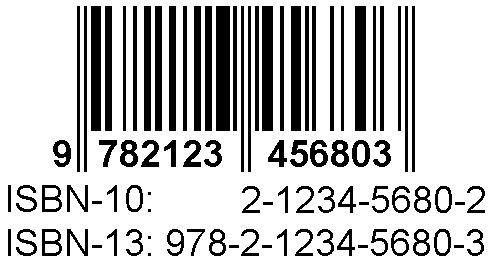
One of the questions I was asked at the Mendocino Coast Writer's Conference was, "What is an ISBN?" There was a great deal of discussion about what that weird bar code on the back of each book means and when a book needs to have one. Not all books do, but if you want to sell a book through a retail outlet, you need one.
Authors don't really need to know what the numbers in the bar code mean (unless their book nerds like me), but every publisher does. The bar code is like the symbol ranchers use to mark their cattle. Every Bar-S ranch cow will have the Bar-S ranch brand. Every Medusa's Muse book will have the numbers 9797152 in their bar code. No other publisher can use those numbers. They are mine, telling stores that the book is a Medusa's Muse book.
Stores use a bar code system to track a books via the book's ISBN. What is a bar code?
From Wikipedia:
A barcode (also bar code) is an optical machine-readable representation of data. Originally, bar codes represented data in the widths (lines) and the spacings of parallel lines, and may be referred to as linear or 1D (1 dimensional) barcodes or symbologies. They also come in patterns of squares, dots, hexagons and other geometric patterns within images termed 2D (2 dimensional) matrix codes or symbologies. Although 2D systems use symbols other than bars, they are generally referred to as barcodes as well.Barcodes can be read by optical scanners called barcode readers, or scanned from an image by special software. In Japan, most mobile phones have built-in scanning software for 2D codes, and similar software is becoming available on smartphone platforms.
If you look at the back of a book you will see a rectangle with two bar codes, usually on the bottom left of the cover. Sometimes there will be a ten digit code, but books published in the last few years will have a 13 digit code. The ISBN standard changed due to the volume of books being published.
The ISBN for What You Need to Know to Be a Pro: The Business Start-Up Guide for Publishers, by Terena Scott, is 978-0-9797152-3-5.
The first three digits identify the type of product it is. 978 means that this is a book.
The next digit identifies the language the book was published in. 0 and 1 are used for English speaking countries.
The center group of numbers is the publisher's ISBN identifier, the brand I wrote of earlier. No other publisher can have the same numbers.
The fourth digit is the number of books published by the publisher. What You Need to Know is the 3rd book published by Medusa's Muse (technically not. This is the second book, but since I set aside two ISBN numbers for Traveling Blind, the next number on the list was the number 3. Nobody cares if the books aren't in order).
The last number is called the check-digit. This is a mathematical variable of the other digits (don't ask me to explain this. Maybe a math person can leave a comment and explain what that means exactly).
You'll see more digits below the code that are the same as the top ISBN digits, but without the dashes. Those numbers show what the bar code means.
Beside the ISBN bar code you'll often see another bar code with numbers on the top. This is the EAN, or European Article Number, which is the world-wide standardization for the sale of books. It tells the price of the book and what system of currency it is sold in. The 5 means that the book is sold in US dollars. What You Need to Know to Be a Pro's EAN looks like this: 5 1 0 0 0, which translates to Ten Dollars US.
And now you know the secret code of an ISBN. Language, currency, price, publisher, and item, all encoded in a bar code for a computer to keep track of books in a store.
Any questions?
Sunday, August 02, 2009
The Mendocino Coast Writer's Conference
On Saturday I was part of a panel called Pathways to Publishing at the Mendocino Coast Writer's Conference. The Mendo Conference is my favorite writer's conference, and not just because it happens at one of the most beautiful places in the world. In only a few days the organizers manage to create a sense of community amongst the attendees based on the love of writing. Everyone is supportive and friendly. There isn't the same competition I've felt at other conferences; participants are genuinely interested in helping each other. Don't think this is a hippi-dippy, kick back kind of conference though. There are agents and editors from New York and the Bay Area offering advice and giving one-on-one consultations as well as award winning writers and poets teaching classes on revision, plot development, character development, writer's block, structure, and pitching. There are lectures about the power of writing to change the world, the needs of a YA reader, and how creative writing and other types of art can stop gangs.
This year I was only able to come for the one day of my talk, but I usually go for the entire three and a half days. In just one day, I met an agent from Manis who was excited about micro-publishinf. I discovered an up and coming author named Benjamin Percy (keep an eye out for him. His short stories are phenomenal. I had lunch with on of my co-panelists,the poet and very funny Robin Ekiss, whose first book debuts this fall. My other co-panelist was Stephanie Freele, whose collection of short stories also debuts this fall.
Our panel went very well and the room was mostly full. We each told how we became published and each of our stories was very different. Stephanie quit her corporate job and got an MFA while Robin went the only route available to poets: contests. I talked about why and how I started my own press and explained all the different paths a writer can take to share their work with the world. The one thing we all focused on was HOPE. Keep trying to get your work out. Keep believing in yourself and your desire to write. Hold fast to your dream. Not all of us will get that contract, but all of us can write and be published. We are not tied to New York City anymore.
Unfortunately I had to leave shortly after the panel. I would have loved to stay and soak up more of that cool, Mendocino Coast air and creative energy, but life is too hectic now days for that. Next year, though. And maybe I'll see you there.
This year I was only able to come for the one day of my talk, but I usually go for the entire three and a half days. In just one day, I met an agent from Manis who was excited about micro-publishinf. I discovered an up and coming author named Benjamin Percy (keep an eye out for him. His short stories are phenomenal. I had lunch with on of my co-panelists,the poet and very funny Robin Ekiss, whose first book debuts this fall. My other co-panelist was Stephanie Freele, whose collection of short stories also debuts this fall.
Our panel went very well and the room was mostly full. We each told how we became published and each of our stories was very different. Stephanie quit her corporate job and got an MFA while Robin went the only route available to poets: contests. I talked about why and how I started my own press and explained all the different paths a writer can take to share their work with the world. The one thing we all focused on was HOPE. Keep trying to get your work out. Keep believing in yourself and your desire to write. Hold fast to your dream. Not all of us will get that contract, but all of us can write and be published. We are not tied to New York City anymore.
Unfortunately I had to leave shortly after the panel. I would have loved to stay and soak up more of that cool, Mendocino Coast air and creative energy, but life is too hectic now days for that. Next year, though. And maybe I'll see you there.
Wednesday, July 29, 2009
Pathways to Publishing.
I'm presenting at the Mendocino Coast Writer's Conference this Saturday on the Pathways to Publishing Panel. It's got me thinking about all the ways there are to get published now days and how lucky we are to not be dependent on publishing companies anymore.
Not that publishing companies are bad! Hell, I am one. But if you don't want to go the route of finding a publisher, you now have many options. In fact, there are FIVE options to get your work out where other people can read it.
Option One - The Traditional Route. This is the one where you find an agent and then the two of you hunt for a publisher, preferably a BIG PUBLISHER, who can give you a BIG ADVANCE and market the book enough that it sells. This is the pot of gold for an author. We all dream of making a deal with Random House or Hatchet and selling thousands of copies of our novel. But competition is fierce and the odds of you actually landing that book deal are slim, especially now days with publishing companies being forced to make budget cuts.
Happily, there are other options.
Option Two- The Micro Publishing Route. This is where you'll find publishing companies like Medusa's Muse. We typically don't work with agents, nor can we afford much of an advance, if at all. But we do offer lots of editorial support and marketing help, as well as making you feel more like you're part of a team than a product. Your book is published by a legitimate publisher, but the odds of selling thousands of copies are slim. No one gets rich in the micro publishing route, and your book may never make the splash you'd like simply because a micro publisher's marketing budget is as micro as the company.
Option Three- The Subsidized Publishing Route. If you'd like to bypass hunting for a publisher but would still like a chance of selling your book, then this is the route for you. This is where you'll find online publishing companies like XLibros and IUniverse. Subsidy publishing has changed for the better over the last decade and a lot of the stigma has disappeared. Working with a subsidy publisher is quick and easy. They'll design and edit your book, for a fee of course. It isn't cheap going this route, and many people have been unhappy with the final result. Plus, you don't own the ISBN, the subsidy publisher does, so that means you don't actually own the book. If that bothers you, then perhaps you should follow option four.
Option Four- The Self Publishing Route. You do it all if you self-publish (so you'll probably want to buy my book, What You Need to Know to Be a Pro). You write it, hire people yourself to edit and design it, send it to a printer, market the book, and sell copies, often from the back of your own car. You will be an author and a business owner, so you also get to do the bookkeeping and track inventory. You'll need a block of ISBN's and a resale license. But all that work allows you to control everything about your book. It's yours, and no one, not an agent or a publishing executive, can tell you what to do. All the profits are yours too. But will it make up for the hours of labor you'll need to put into self-publishing?
Option Five- The Electronic Publishing Route. This is the age of the Internet, so use it. Set up a blog and a website to publish your writing on the net. Post a chapter at a time to serialize your book and start networking with other writers and people who may be interested in your topic to get readers. You won't make any money this way, but you build a following over time which can eventually lead to money in the future, especially if one of those agents we mentioned in Option One likes your work.
I suppose there is an Option Six as well. You can do nothing at all.
Not that publishing companies are bad! Hell, I am one. But if you don't want to go the route of finding a publisher, you now have many options. In fact, there are FIVE options to get your work out where other people can read it.
Option One - The Traditional Route. This is the one where you find an agent and then the two of you hunt for a publisher, preferably a BIG PUBLISHER, who can give you a BIG ADVANCE and market the book enough that it sells. This is the pot of gold for an author. We all dream of making a deal with Random House or Hatchet and selling thousands of copies of our novel. But competition is fierce and the odds of you actually landing that book deal are slim, especially now days with publishing companies being forced to make budget cuts.
Happily, there are other options.
Option Two- The Micro Publishing Route. This is where you'll find publishing companies like Medusa's Muse. We typically don't work with agents, nor can we afford much of an advance, if at all. But we do offer lots of editorial support and marketing help, as well as making you feel more like you're part of a team than a product. Your book is published by a legitimate publisher, but the odds of selling thousands of copies are slim. No one gets rich in the micro publishing route, and your book may never make the splash you'd like simply because a micro publisher's marketing budget is as micro as the company.
Option Three- The Subsidized Publishing Route. If you'd like to bypass hunting for a publisher but would still like a chance of selling your book, then this is the route for you. This is where you'll find online publishing companies like XLibros and IUniverse. Subsidy publishing has changed for the better over the last decade and a lot of the stigma has disappeared. Working with a subsidy publisher is quick and easy. They'll design and edit your book, for a fee of course. It isn't cheap going this route, and many people have been unhappy with the final result. Plus, you don't own the ISBN, the subsidy publisher does, so that means you don't actually own the book. If that bothers you, then perhaps you should follow option four.
Option Four- The Self Publishing Route. You do it all if you self-publish (so you'll probably want to buy my book, What You Need to Know to Be a Pro). You write it, hire people yourself to edit and design it, send it to a printer, market the book, and sell copies, often from the back of your own car. You will be an author and a business owner, so you also get to do the bookkeeping and track inventory. You'll need a block of ISBN's and a resale license. But all that work allows you to control everything about your book. It's yours, and no one, not an agent or a publishing executive, can tell you what to do. All the profits are yours too. But will it make up for the hours of labor you'll need to put into self-publishing?
Option Five- The Electronic Publishing Route. This is the age of the Internet, so use it. Set up a blog and a website to publish your writing on the net. Post a chapter at a time to serialize your book and start networking with other writers and people who may be interested in your topic to get readers. You won't make any money this way, but you build a following over time which can eventually lead to money in the future, especially if one of those agents we mentioned in Option One likes your work.
I suppose there is an Option Six as well. You can do nothing at all.
Monday, July 27, 2009
Goodbye Merce Cunningham

from the BBC:
US choreographer Merce Cunningham, widely recognised for revolutionising modern dance, has died "of natural causes" at the age of 90.
In a statement, the Cunningham Dance Foundation, which he founded in 1953, said that he "revolutionised the visual and performing arts, not for the sake of iconoclasm, but for the beauty and wonder that lay in exploring new possibilities".
Follow the link to see video of some of his work, and hear him speak about courage.
"Courage... when you're doing something that you want to do. You may even not know how to do it, but you still want to do it, so you go ahead and try..." Merce Cunningham.
May we all live such long, vibrant and creative lives.
Saturday, July 25, 2009
Writing the Punk Rock Introduction
At last, the punk book is DONE. Well... mostly.
I know I already said the book was done, but what I meant is that the writers are done. And my editing is done. Now the designer has to lay out everything and add some awesome photos.
But first, I have to write the intro.
Yep, I got everyone's parts completed but neglected to finish (as in start) my own.
And now I'm looking at this lap stop screen with a completely blank brain.
I need to write my own punk rock story and explain how that inspired Punk Rock Saved My Ass.
So let's see...Well... Once upon a time there was a hippi girl who met a punk boy and she fell in love with his music. Even though the relationship didn't last, her love of punk did... and that's why she put this book together... the end.
Yeah. That could work. Too short to suck is always a good thing.
I'm thinking I need to flush it out a bit more, though.
Dang.
If you need me, I'll be trying to explain how this Hippi Chick from Northern California came to love Punk Rock music. Is there such a thing as a Hippi-Punk?
I know I already said the book was done, but what I meant is that the writers are done. And my editing is done. Now the designer has to lay out everything and add some awesome photos.
But first, I have to write the intro.
Yep, I got everyone's parts completed but neglected to finish (as in start) my own.
And now I'm looking at this lap stop screen with a completely blank brain.
I need to write my own punk rock story and explain how that inspired Punk Rock Saved My Ass.
So let's see...Well... Once upon a time there was a hippi girl who met a punk boy and she fell in love with his music. Even though the relationship didn't last, her love of punk did... and that's why she put this book together... the end.
Yeah. That could work. Too short to suck is always a good thing.
I'm thinking I need to flush it out a bit more, though.
Dang.
If you need me, I'll be trying to explain how this Hippi Chick from Northern California came to love Punk Rock music. Is there such a thing as a Hippi-Punk?
Thursday, July 23, 2009
Who is Medusa's Muse?
That question has been haunting me lately. Who is Medusa's Muse? What do the words, Medusa's Muse mean? And what do I want to do with my press, and this blog?
Since I started grad school in September last year, the majority of my energy has gone into intellectual, analytical, systematic thinking. School requires this kind of work. At the same time I was writing a factual, how-to hand-book on starting a publishing company (What You Need to Know to Be a Pro: The Business Start-Up Guide for Publishers, by Terena Scott). Between homework, managing my press, finishing a non-fiction book, and taking care of my daughter's needs, I had almost no time for creative thought. The biggest creative outlet I had in the past 12 months has been The Sims (Yes, it is a creative outlet. Just ask my Sims family). But playing the Sims isn't writing.
My brain is weary from all that linear thinking. I need some creative, imaginative expression.
I'm looking for more balance in my life which has me questioning my choices. School is important so I won't give that up, and Medusa's Muse is my passion. Eventually I'll be finished with school which means I'll be working while also raising my child. How will I have time to keep Medusa's Muse going?
That's why I'm asking: Who is Medusa's Muse? What kind of books do I want to publish? What kind of writers do I want to work with? And is Medusa's Muse only about books and writing? What more can I do to keep my wild, creatively fueled mind thriving?
It also feels like this blog needs to change. But in what way? I'd like to expand the focus on ways to feed all of our muses so that we are creatively alive. Of course I will continue sharing information about running a book press and news on the industry, because it is just as important to know how to manage your inventory and market your books as it is to be artistic. A thriving artist needs to be practical as well as imaginative. You have to work hard so you can pay the electric bill. It's impossible to use your lap top when the battery is dead. But don't work so hard your creative muscles atrophy. Great artists need inspiration and imagination, as well as food and shelter.
My Muse is smiling at me right now because I finally have the answer. Who is Medusa's Muse? She is the Muse of practical imagination.
Since I started grad school in September last year, the majority of my energy has gone into intellectual, analytical, systematic thinking. School requires this kind of work. At the same time I was writing a factual, how-to hand-book on starting a publishing company (What You Need to Know to Be a Pro: The Business Start-Up Guide for Publishers, by Terena Scott). Between homework, managing my press, finishing a non-fiction book, and taking care of my daughter's needs, I had almost no time for creative thought. The biggest creative outlet I had in the past 12 months has been The Sims (Yes, it is a creative outlet. Just ask my Sims family). But playing the Sims isn't writing.
My brain is weary from all that linear thinking. I need some creative, imaginative expression.
I'm looking for more balance in my life which has me questioning my choices. School is important so I won't give that up, and Medusa's Muse is my passion. Eventually I'll be finished with school which means I'll be working while also raising my child. How will I have time to keep Medusa's Muse going?
That's why I'm asking: Who is Medusa's Muse? What kind of books do I want to publish? What kind of writers do I want to work with? And is Medusa's Muse only about books and writing? What more can I do to keep my wild, creatively fueled mind thriving?
It also feels like this blog needs to change. But in what way? I'd like to expand the focus on ways to feed all of our muses so that we are creatively alive. Of course I will continue sharing information about running a book press and news on the industry, because it is just as important to know how to manage your inventory and market your books as it is to be artistic. A thriving artist needs to be practical as well as imaginative. You have to work hard so you can pay the electric bill. It's impossible to use your lap top when the battery is dead. But don't work so hard your creative muscles atrophy. Great artists need inspiration and imagination, as well as food and shelter.
My Muse is smiling at me right now because I finally have the answer. Who is Medusa's Muse? She is the Muse of practical imagination.
Monday, July 20, 2009
Gifts from my Muse
My Muse did a great job encouraging me to focus on my creativity and let go of some of my task oriented, linear way of living. And then as soon as the temperature passed 100, she vanished, complaining that her snake-filled hair was too sweaty. I'm pretty sure she went to Hunter S Thompson's memorial birthday party which Johnny Depp was hosting on his yacht, but she never tells me what her plans are. "A Muse doesn't have to explain," she says, just before vanishing in a puff of snake scented smoke.
That's a muse for you; wonderful when you need a good push, but not there to catch you on the other end.
It's a good thing I'm used to her disappearing acts. She appears in a rush of inspiration and insight, then is gone when the wind changes direction, like a sexy, incandescent Mary Poppins. After one of her trips, she brings back stories wrapped in shiny paper and gives them to me. "This one came from the top of Mt. Denali. Be careful, it's very cold. And this fancy one is from a nightclub in Berlin. I thought you'd like the music." She fills me up with characters and ideas and then commands me to write.
I'm lucky. I've never felt like I had nothing to write about. My problem is I have too many stories in my head. My muse is generous, filling me to the brim until I can't absorb one more image and I beg her to stop because I'm feeling sick. "Nonsense," she says. "No one ever died from too many stories. Writers kill themselves when they run out."
I've begun work on a new novel, and it feels wonderful to write something creative again. This time I have no deadline, no set goal, and no sense of impending failure (at least not yet). The story has been in my head for a couple of years and is finally being transformed into words. Because the characters have lived inside me for so long, they flow out from my imagination fully formed and speaking scenes of dialogue. What a relief to write this story after so many months of textbooks and nonfiction. And the fact the Punk book is finished gives me more time to create my own worlds.
And yes, I do still need to double check the invoices before paying the State of California its Sales Tax. Tomorrow. Right now I'm going to write.
That's a muse for you; wonderful when you need a good push, but not there to catch you on the other end.
It's a good thing I'm used to her disappearing acts. She appears in a rush of inspiration and insight, then is gone when the wind changes direction, like a sexy, incandescent Mary Poppins. After one of her trips, she brings back stories wrapped in shiny paper and gives them to me. "This one came from the top of Mt. Denali. Be careful, it's very cold. And this fancy one is from a nightclub in Berlin. I thought you'd like the music." She fills me up with characters and ideas and then commands me to write.
I'm lucky. I've never felt like I had nothing to write about. My problem is I have too many stories in my head. My muse is generous, filling me to the brim until I can't absorb one more image and I beg her to stop because I'm feeling sick. "Nonsense," she says. "No one ever died from too many stories. Writers kill themselves when they run out."
I've begun work on a new novel, and it feels wonderful to write something creative again. This time I have no deadline, no set goal, and no sense of impending failure (at least not yet). The story has been in my head for a couple of years and is finally being transformed into words. Because the characters have lived inside me for so long, they flow out from my imagination fully formed and speaking scenes of dialogue. What a relief to write this story after so many months of textbooks and nonfiction. And the fact the Punk book is finished gives me more time to create my own worlds.
And yes, I do still need to double check the invoices before paying the State of California its Sales Tax. Tomorrow. Right now I'm going to write.
Saturday, July 18, 2009
Happy Birthday, Dr. Hunter S Thompson

A Muse of my Muse, the good Dr. Thompson. A man who danced on the edge of the cliff singing loud Puerto Rican songs with a glass of scotch in one hand and a pistol in the other. Insane, destructive, beautiful, and extremely talented. Let us all raise a toast to a true original.
There will never be another Dr. Hunter S Thompson.
Monday, July 13, 2009
The Muse is Back!
Greetings to you lovely Medusa fans. This is Muse, taking over for Terena because she seems to be suffering from post-semester brain block. This is a common problem with all people who think too much and have spent a great deal of time focused on one highly complex task for too long. She spent five weeks doing nothing but reading text books and writing opinion papers on subjects such as the Pro and Con of discussing budgetary issues during an IEP and the merits and deficiencies of multi-cultural education. Before summer semester, she wrote a how-to book about starting a small press (What You Need to Know to Be a Pro: The Start-Up Business Guide for Publishers) while at the same time going to Graduate School.I have been mostly silent for 8 months, allowing her time to get through this period of single minded dedication to intellect. But no longer.
Today I found her mumbling over inventory lists in preparation for paying sales tax ("Do I pay 8.75% on sales after April 1, or for all sales of that fiscal year?"). Enough is enough! I grabbed her I POD, set it to play every Pearl Jam song she owns, and pushed her out the front door. "Go for a walk and don't stop until you're worn out!"
"But..." she began.
"No buts. I've had it with all this cerebral, non-creative, linear thinking. Go walk it off."
She lowered her head and pouted but did as she was told.
It's all good and well to focus on work that must be done. Eventually Terena will need to get the sales tax paid, and I'm proud of her for being so dedicated to school. But school is over and she can pay the bills next week. I'm taking control of Medusa's Muse now and steering it back on a more imaginative, creatively passionate, productively wild, course.
After all, a Muse can not live by text books alone.
Today I found her mumbling over inventory lists in preparation for paying sales tax ("Do I pay 8.75% on sales after April 1, or for all sales of that fiscal year?"). Enough is enough! I grabbed her I POD, set it to play every Pearl Jam song she owns, and pushed her out the front door. "Go for a walk and don't stop until you're worn out!"
"But..." she began.
"No buts. I've had it with all this cerebral, non-creative, linear thinking. Go walk it off."
She lowered her head and pouted but did as she was told.
It's all good and well to focus on work that must be done. Eventually Terena will need to get the sales tax paid, and I'm proud of her for being so dedicated to school. But school is over and she can pay the bills next week. I'm taking control of Medusa's Muse now and steering it back on a more imaginative, creatively passionate, productively wild, course.
After all, a Muse can not live by text books alone.
Thursday, July 09, 2009
Editing an Author's Work
From the book, What You Need to Know to Be a Pro: The Start-Up Business Guide for Publishers, by Terena Scott
Editing is my favorite part of publishing, the time when you and the author work together to transform the manuscript into a work of art. This is also when you build your relationship with the author and create trust. Editing an author's work requires compassion, dedication, mediation skills, humor, and vigilance. You must find a way to help an author see what improvements need to be made without destroying their often delicate egos. A weepy author can't get any work done, but while you’re supporting them emotionally and creatively, you also need to be tough about deadlines. And don’t be afraid to use your red pen. You are a professional and you need the author to be professional too. Be honest about what needs to be fixed and clear about your expectations.
When critiquing, I start with what's working, and then point out what needs improvement. Usually there's a lot that needs to be changed, so I continue to point out the positives while finding the negatives. It is important to be as specific as possible when offering suggestions. Try not to say things like, "This isn't working for me." Instead, say, "This section feels preachy. Ground it in sensory details and focus more on the character than the message."
Occasionally, you and the author will disagree, and that's when you need to decide if the edit is important. The publisher has the final say and the author must defer to your opinion. Don't make demands the author can't provide, though. This is still the author's voice, her work, her writing, so she isn't going to write like you. If it's a minor detail, let it go. If it changes the plot profoundly, you may need to insist. When working with Laura, she was very attached to her descriptions of the landscape. I wanted those descriptions cut and the focus put back on the action. Slowly she cut them down from several pages to one page, then to a few paragraphs. After many months, I was satisfied with the amount of description remaining. I wanted even more cuts, but I let it go because the remaining descriptions didn't distract too much from the book's pacing. I decided to let her keep some of her descriptions, remembering it was her writing style, not mine.
In the example contract provided above, there is a clause that allows both of you to pull out during the editing process. If the author can't deliver a manuscript acceptable to the publisher by a certain date, the contract is void. She gets her work back and you are free to find a different project. Every now and then, it happens.
Editing is my favorite part of publishing, the time when you and the author work together to transform the manuscript into a work of art. This is also when you build your relationship with the author and create trust. Editing an author's work requires compassion, dedication, mediation skills, humor, and vigilance. You must find a way to help an author see what improvements need to be made without destroying their often delicate egos. A weepy author can't get any work done, but while you’re supporting them emotionally and creatively, you also need to be tough about deadlines. And don’t be afraid to use your red pen. You are a professional and you need the author to be professional too. Be honest about what needs to be fixed and clear about your expectations.
When critiquing, I start with what's working, and then point out what needs improvement. Usually there's a lot that needs to be changed, so I continue to point out the positives while finding the negatives. It is important to be as specific as possible when offering suggestions. Try not to say things like, "This isn't working for me." Instead, say, "This section feels preachy. Ground it in sensory details and focus more on the character than the message."
Occasionally, you and the author will disagree, and that's when you need to decide if the edit is important. The publisher has the final say and the author must defer to your opinion. Don't make demands the author can't provide, though. This is still the author's voice, her work, her writing, so she isn't going to write like you. If it's a minor detail, let it go. If it changes the plot profoundly, you may need to insist. When working with Laura, she was very attached to her descriptions of the landscape. I wanted those descriptions cut and the focus put back on the action. Slowly she cut them down from several pages to one page, then to a few paragraphs. After many months, I was satisfied with the amount of description remaining. I wanted even more cuts, but I let it go because the remaining descriptions didn't distract too much from the book's pacing. I decided to let her keep some of her descriptions, remembering it was her writing style, not mine.
In the example contract provided above, there is a clause that allows both of you to pull out during the editing process. If the author can't deliver a manuscript acceptable to the publisher by a certain date, the contract is void. She gets her work back and you are free to find a different project. Every now and then, it happens.
Tuesday, July 07, 2009
How to Tell When You've Reached the Limit of What You Can Manag
When you forget which day it is and therefor go the wrong appointment, you've reached the limit.
When you can't answer simple questions like what you ate for breakfast without staring into space trying to understand what the word breakfast means, you've reached the limit.
When your to do list has more than six subheadings, you've reached the limit.
When it's the last month of the last quarter of the Fiscal year and you don't know where the invoice file went, you've reached the limit.
When your book gets a wonderful review and it takes you a week to tell your friends and family, let alone post it on your blog, you've reached the limit.
When your website still doesn't have an image of your book's cover after three months, you've reached the limit
When you groan every time the phone rings, or open your inbox, you've reached the limit.
When all you want to do is play the Sims, you've reached the limit.
When you can't figure out what to do when you've reached the limit, you have definitely reached the limit.
Now what?
When you can't answer simple questions like what you ate for breakfast without staring into space trying to understand what the word breakfast means, you've reached the limit.
When your to do list has more than six subheadings, you've reached the limit.
When it's the last month of the last quarter of the Fiscal year and you don't know where the invoice file went, you've reached the limit.
When your book gets a wonderful review and it takes you a week to tell your friends and family, let alone post it on your blog, you've reached the limit.
When your website still doesn't have an image of your book's cover after three months, you've reached the limit
When you groan every time the phone rings, or open your inbox, you've reached the limit.
When all you want to do is play the Sims, you've reached the limit.
When you can't figure out what to do when you've reached the limit, you have definitely reached the limit.
Now what?
Saturday, July 04, 2009
Have You Ever Read the Declaration of Independence?
Imagine how it must have felt to be a Colonist in 1776 and hear these words spoken. Your country has just declared war against its Government, The British Empire, the biggest super power on the planet. The odds are so stacked against your country it will be a miracle if anyone survives. Despite certain death, you all agree to fight.
Wow...
IN CONGRESS, JULY 4, 1776
The unanimous Declaration of the thirteen united States of America
When in the Course of human events it becomes necessary for one people to dissolve the political bands which have connected them with another and to assume among the powers of the earth, the separate and equal station to which the Laws of Nature and of Nature's God entitle them, a decent respect to the opinions of mankind requires that they should declare the causes which impel them to the separation.
We hold these truths to be self-evident, that all men are created equal, that they are endowed by their Creator with certain unalienable Rights, that among these are Life, Liberty and the pursuit of Happiness. — That to secure these rights, Governments are instituted among Men, deriving their just powers from the consent of the governed, — That whenever any Form of Government becomes destructive of these ends, it is the Right of the People to alter or to abolish it, and to institute new Government, laying its foundation on such principles and organizing its powers in such form, as to them shall seem most likely to effect their Safety and Happiness. Prudence, indeed, will dictate that Governments long established should not be changed for light and transient causes; and accordingly all experience hath shewn that mankind are more disposed to suffer, while evils are sufferable than to right themselves by abolishing the forms to which they are accustomed. But when a long train of abuses and usurpations, pursuing invariably the same Object evinces a design to reduce them under absolute Despotism, it is their right, it is their duty, to throw off such Government, and to provide new Guards for their future security. — Such has been the patient sufferance of these Colonies; and such is now the necessity which constrains them to alter their former Systems of Government.
Wow...
IN CONGRESS, JULY 4, 1776
The unanimous Declaration of the thirteen united States of America
When in the Course of human events it becomes necessary for one people to dissolve the political bands which have connected them with another and to assume among the powers of the earth, the separate and equal station to which the Laws of Nature and of Nature's God entitle them, a decent respect to the opinions of mankind requires that they should declare the causes which impel them to the separation.
We hold these truths to be self-evident, that all men are created equal, that they are endowed by their Creator with certain unalienable Rights, that among these are Life, Liberty and the pursuit of Happiness. — That to secure these rights, Governments are instituted among Men, deriving their just powers from the consent of the governed, — That whenever any Form of Government becomes destructive of these ends, it is the Right of the People to alter or to abolish it, and to institute new Government, laying its foundation on such principles and organizing its powers in such form, as to them shall seem most likely to effect their Safety and Happiness. Prudence, indeed, will dictate that Governments long established should not be changed for light and transient causes; and accordingly all experience hath shewn that mankind are more disposed to suffer, while evils are sufferable than to right themselves by abolishing the forms to which they are accustomed. But when a long train of abuses and usurpations, pursuing invariably the same Object evinces a design to reduce them under absolute Despotism, it is their right, it is their duty, to throw off such Government, and to provide new Guards for their future security. — Such has been the patient sufferance of these Colonies; and such is now the necessity which constrains them to alter their former Systems of Government.
Thursday, July 02, 2009
The Worst Writing in the Whole World
David McKenzie of Federal Way, Washington was declared the winner of the Bulwer Lytton Fiction Contest, "where www means 'wretched writers welcome." You can also read an interview with David McKenzie in the San Jose Mercury News.
Follow this link to see his submission, and then try to out do him. Writing bad isn't as easy as it looks.
Here's my attempt:
The road passed the red break house and just kept going, over the horizon to places unseen, never to be seen, by the little girl in the green dress who lived in the red brick house. She wished she could go there, but she had to stay in the yard and watch the cars go by, far away. It made her sad.
Your turn.
Follow this link to see his submission, and then try to out do him. Writing bad isn't as easy as it looks.
Here's my attempt:
The road passed the red break house and just kept going, over the horizon to places unseen, never to be seen, by the little girl in the green dress who lived in the red brick house. She wished she could go there, but she had to stay in the yard and watch the cars go by, far away. It made her sad.
Your turn.
Wednesday, July 01, 2009
Micheal Jackson

I am not what you'd call a Micheal Jackson fan, although I respected his incredible talent. This is a man who was truly unique in the full definition of the word. There was never anyone like him, and I doubt there will ever be another.
His life was tragic. He was so flawed, so gifted, so shattered. As he aged, he seemed to become more and more unreal, alienated from himself and everyone around him. He never had a chance to live in the real world, so he had no grasp of what real was. His talent helped him survive, but also destroyed him. He may have been the loneliest man in the world, despite the fact he was surrounded by millions who adored him.
When Thriller came out in 1983, I had a paper route. Since I lived in the country, I couldn't ride a bicycle to all the homes (spread out over 30 miles), so my mom and I drove a car and blasted Thriller as loud as we dared at 6:00 am on a Sunday. The album became our paper route anthem. To this day I can't help but sing along to Thriller.
Whether you are a fan or not, you can't deny the incredible impact Micheal Jackson has had on our culture and ourselves.
The world does seem emptier now that Micheal is gone.
Subscribe to:
Posts (Atom)